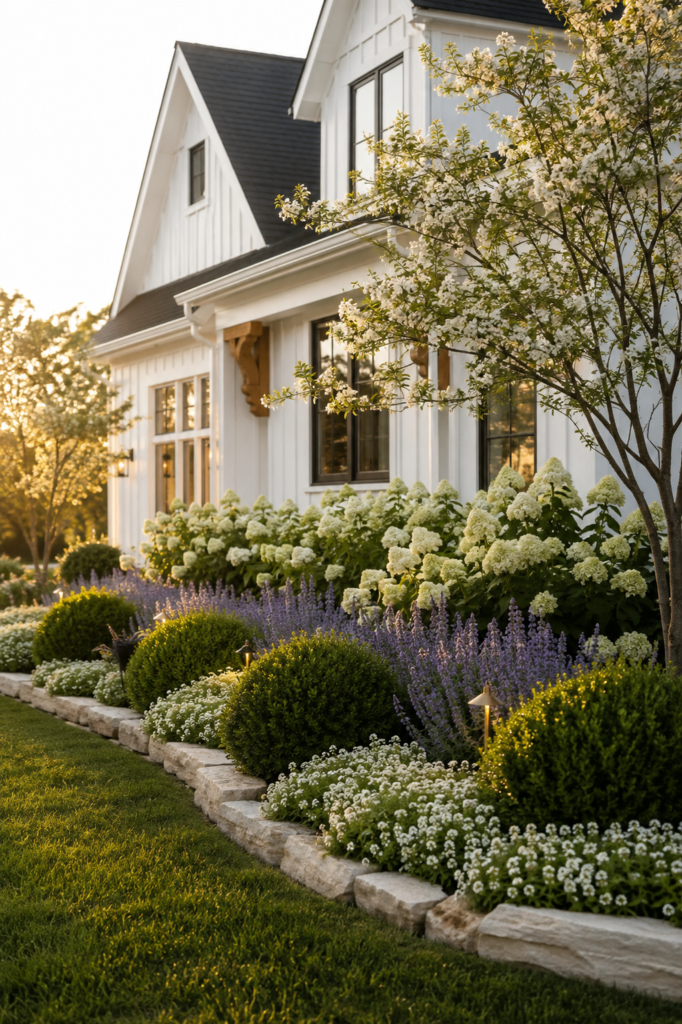
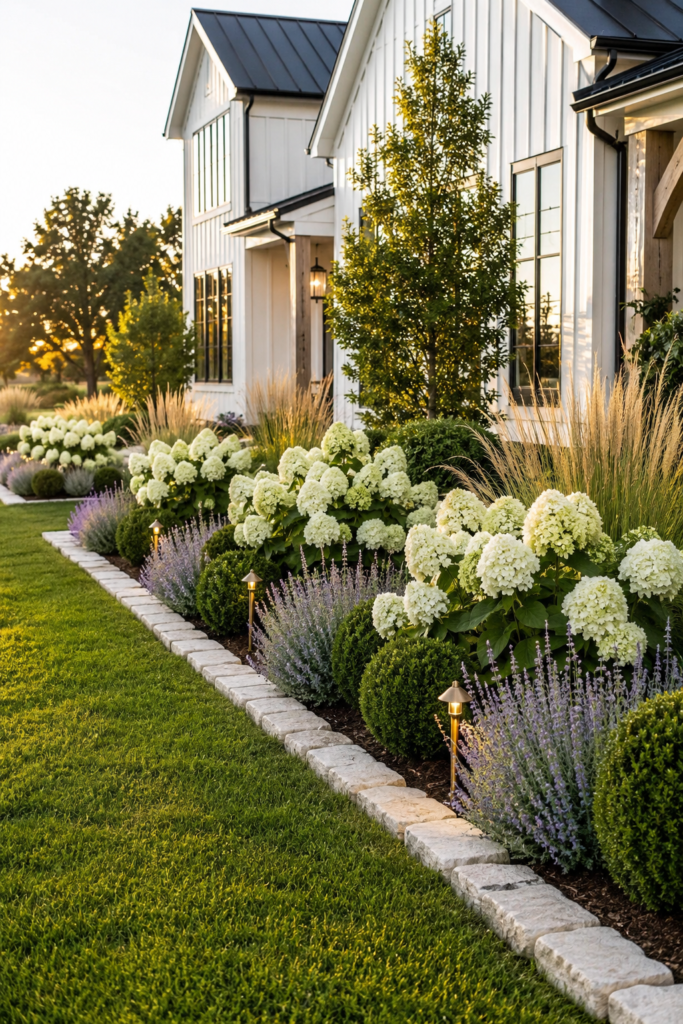
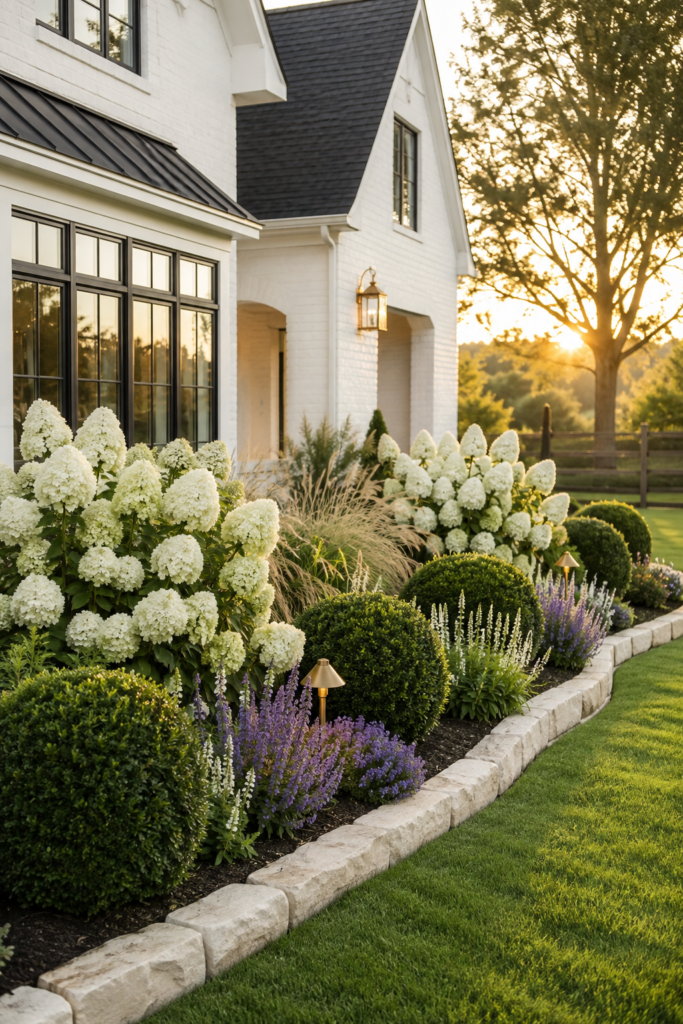
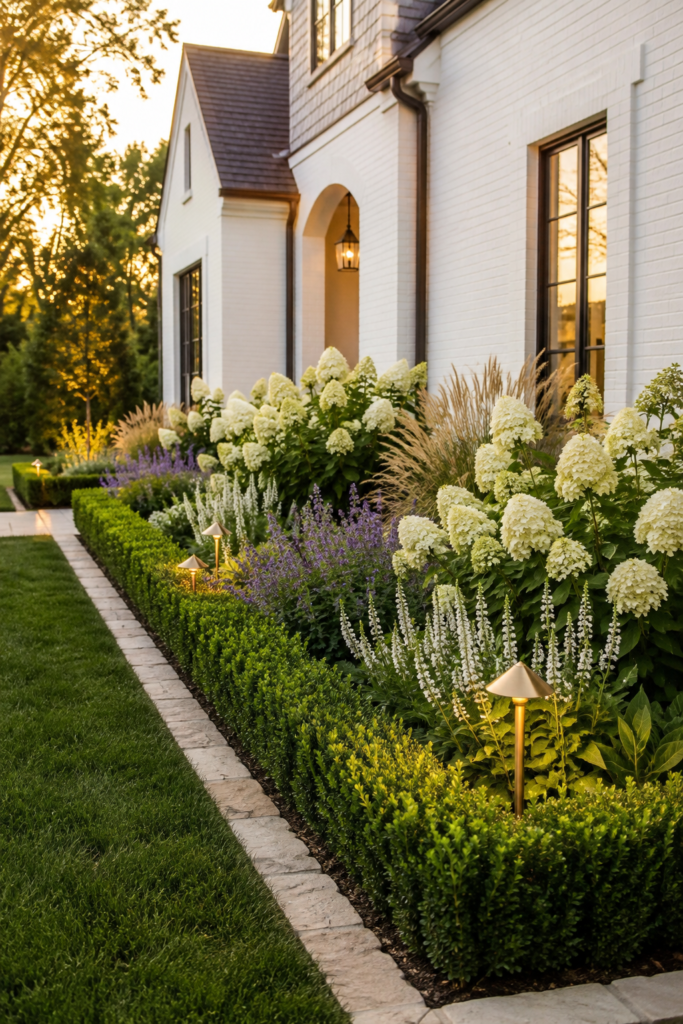
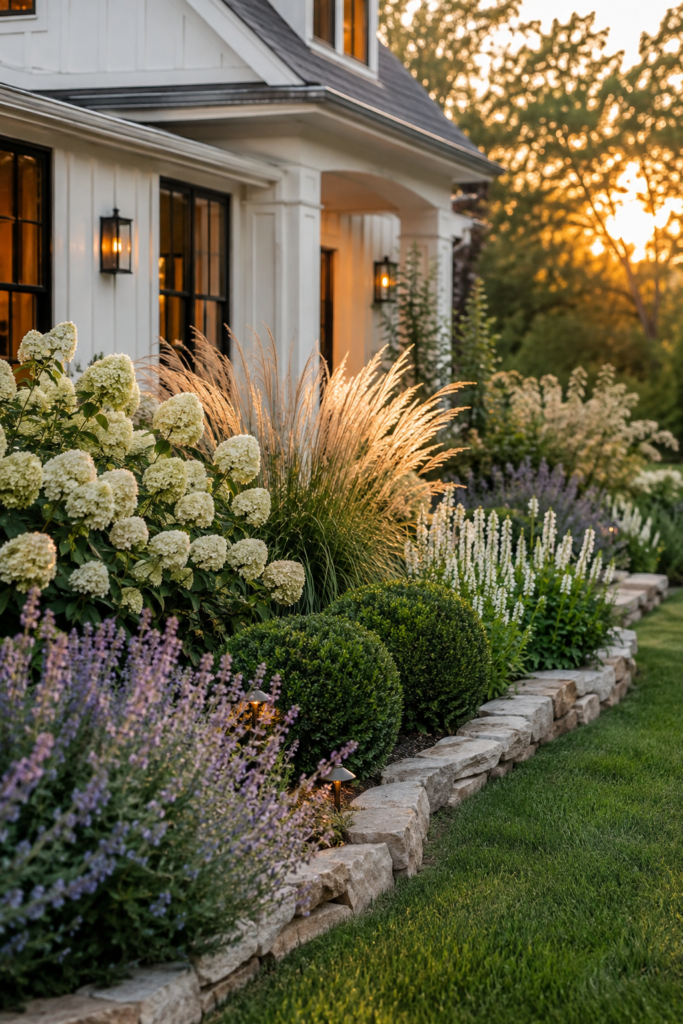
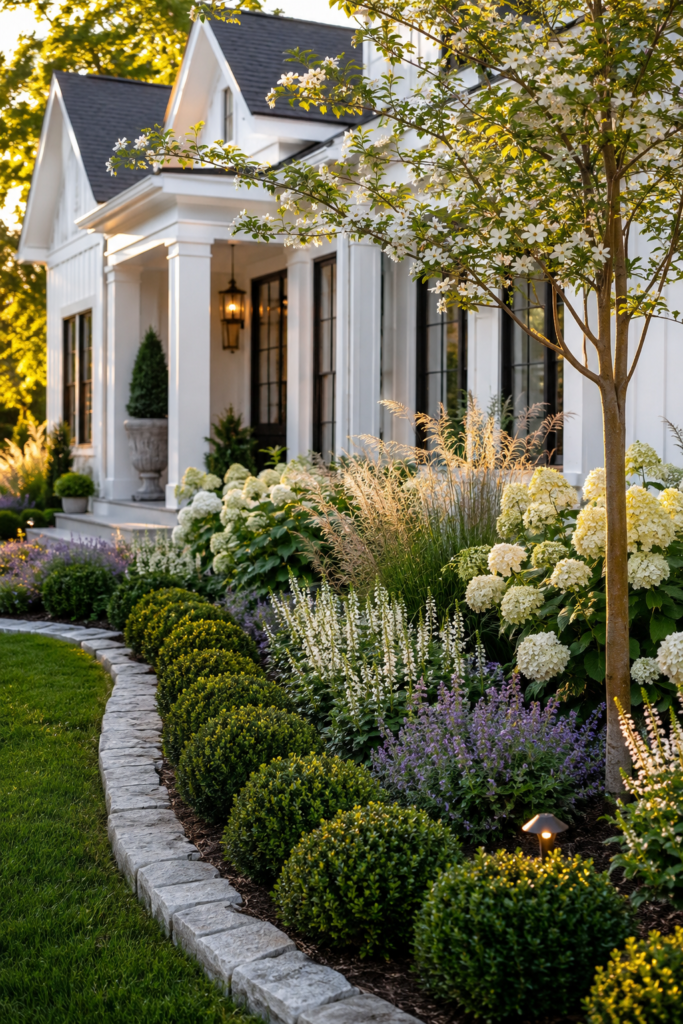
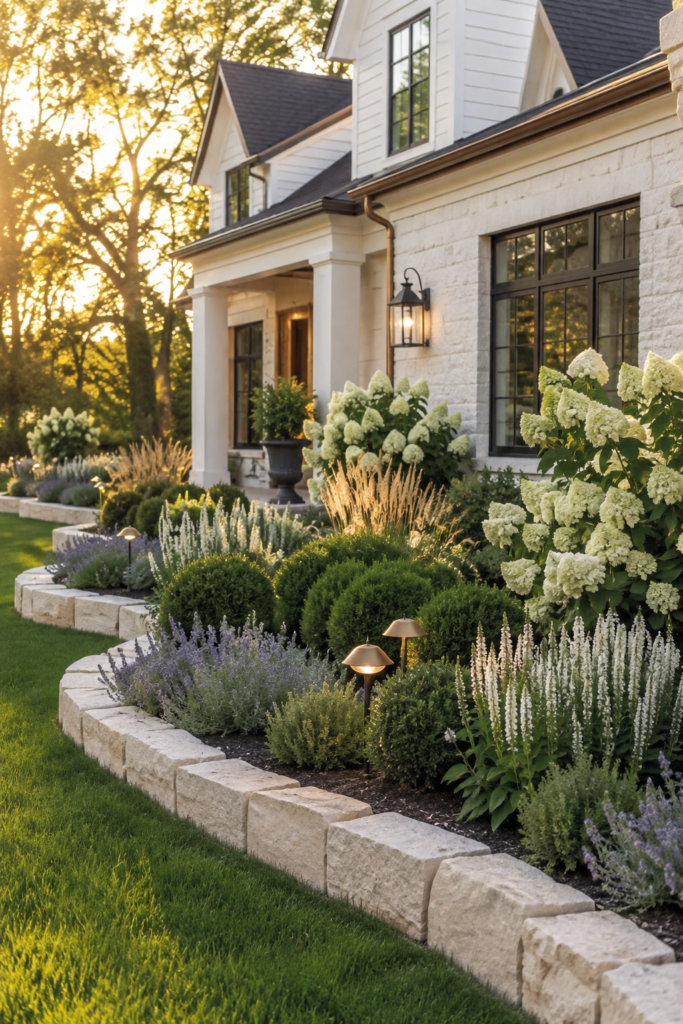
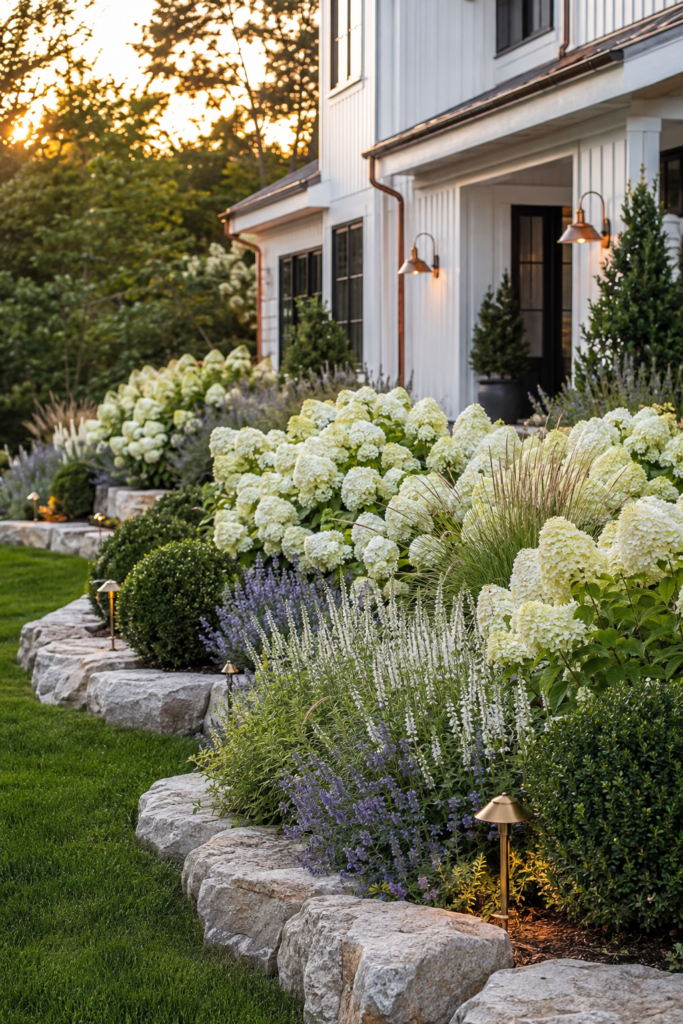
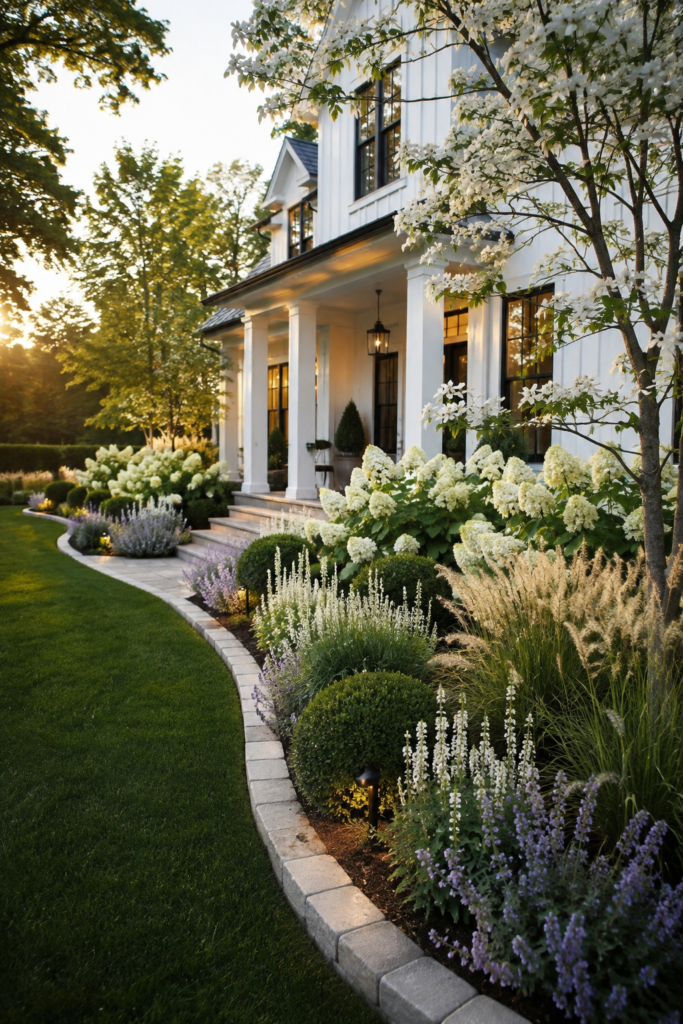
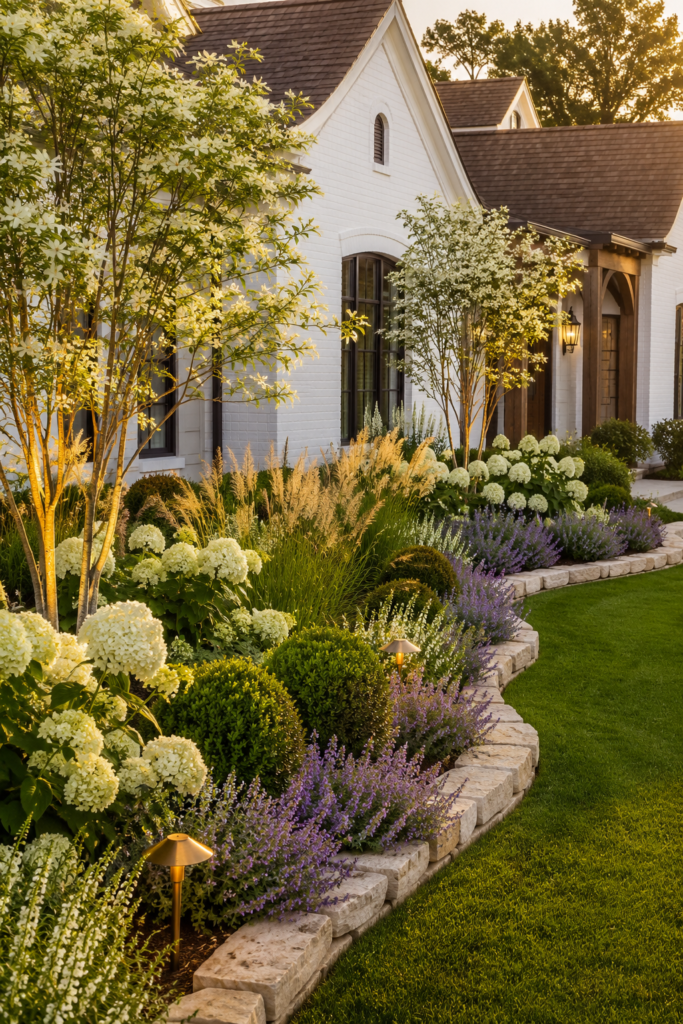
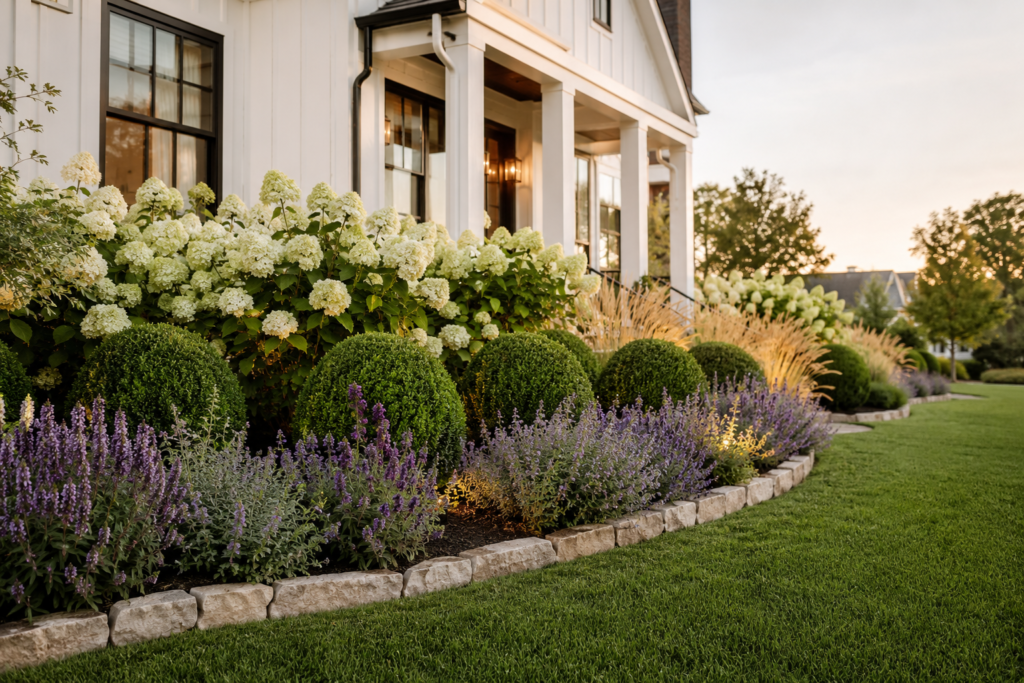
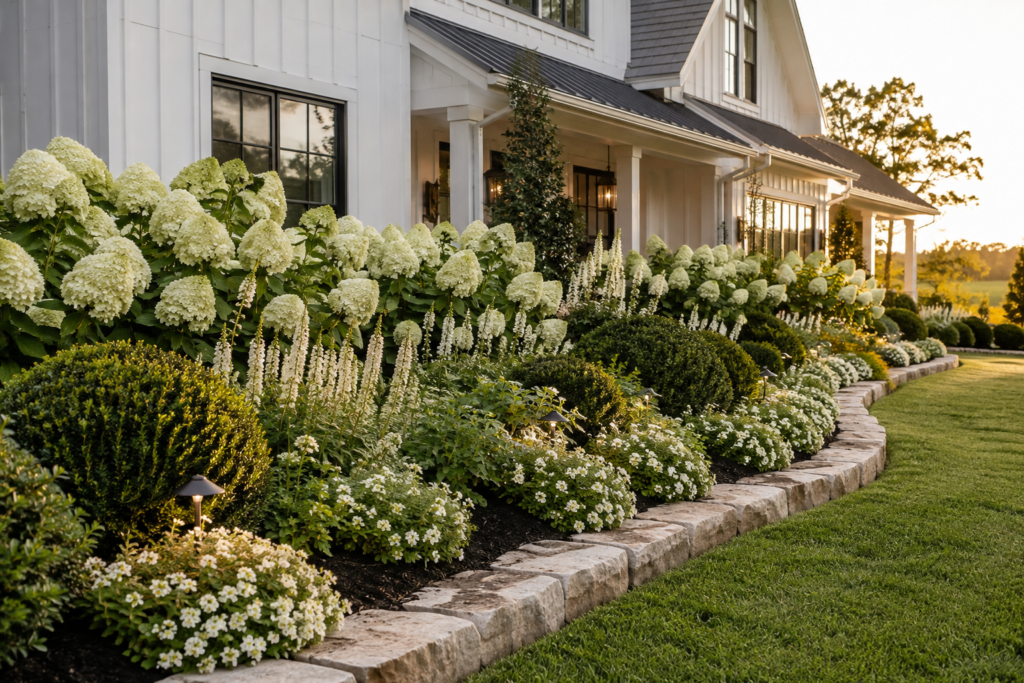
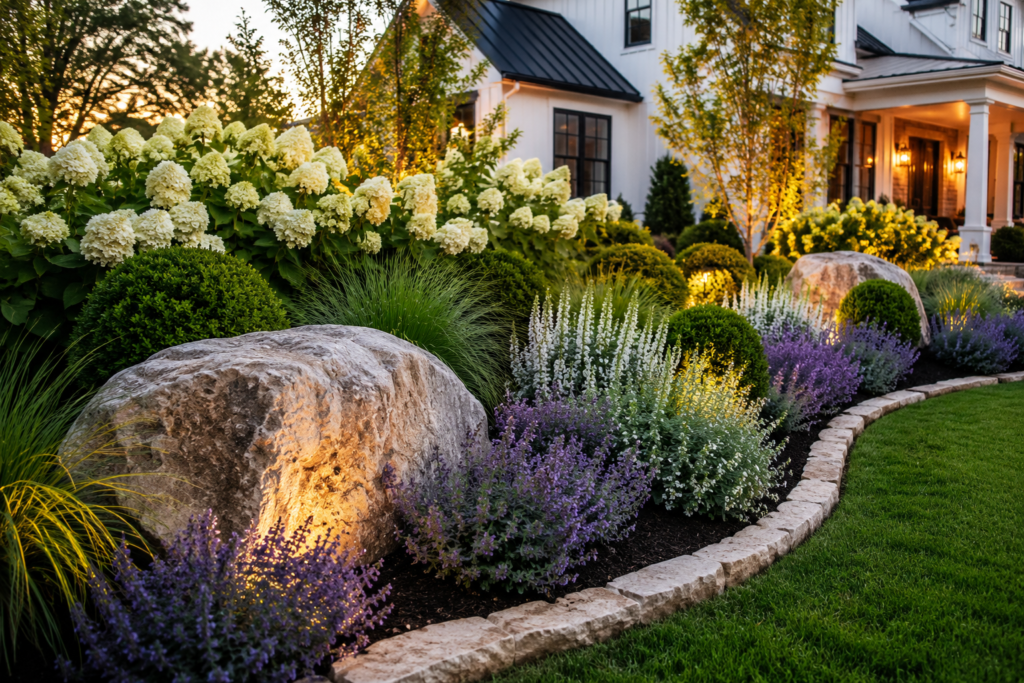
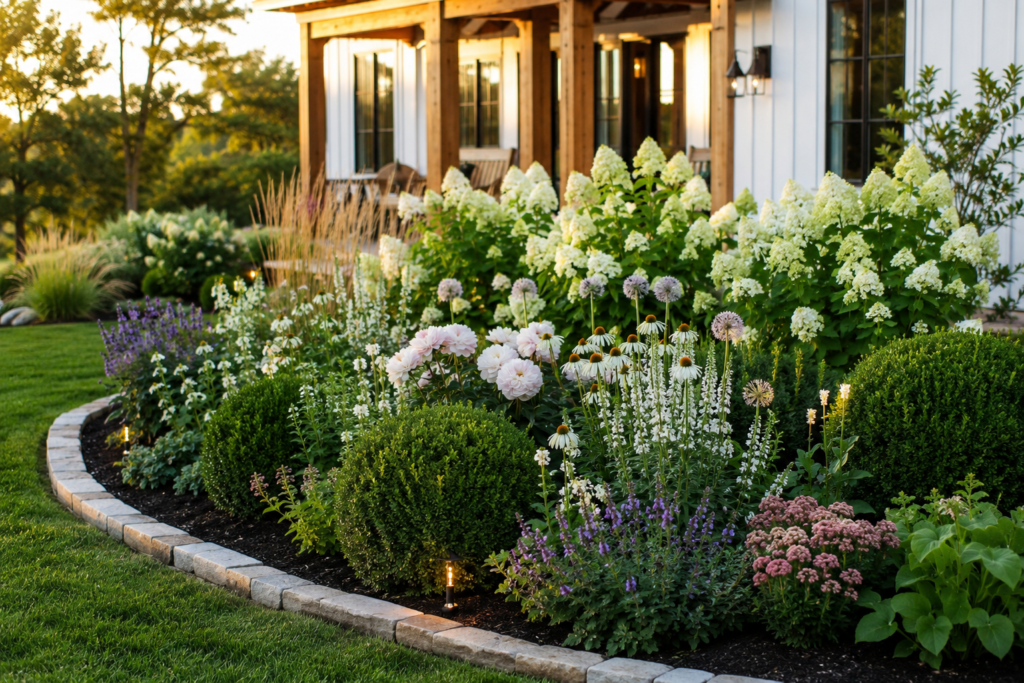
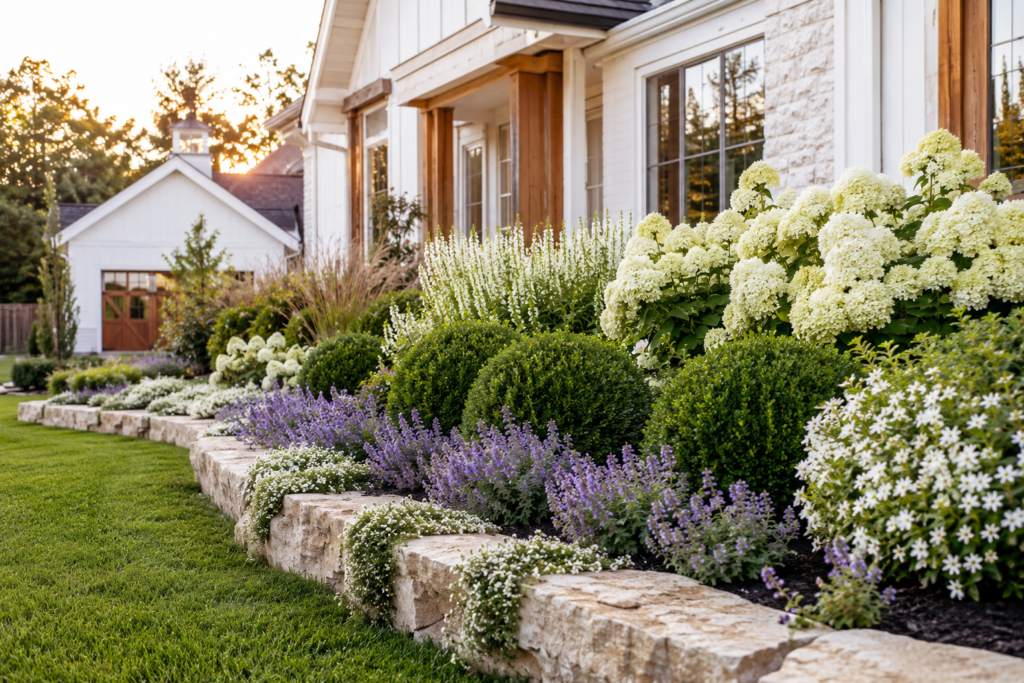
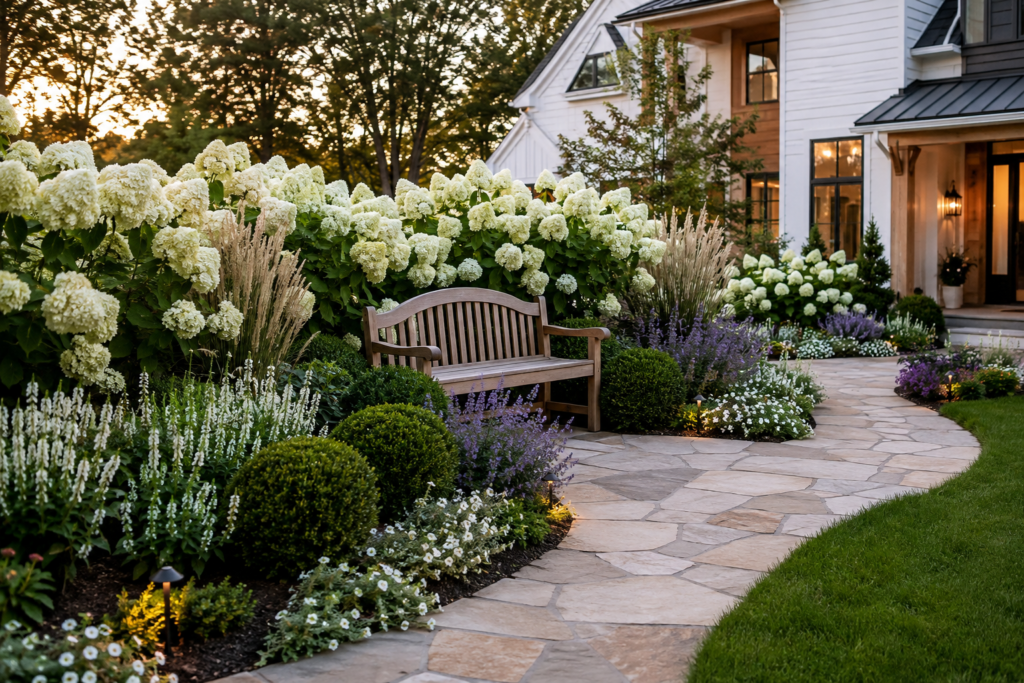
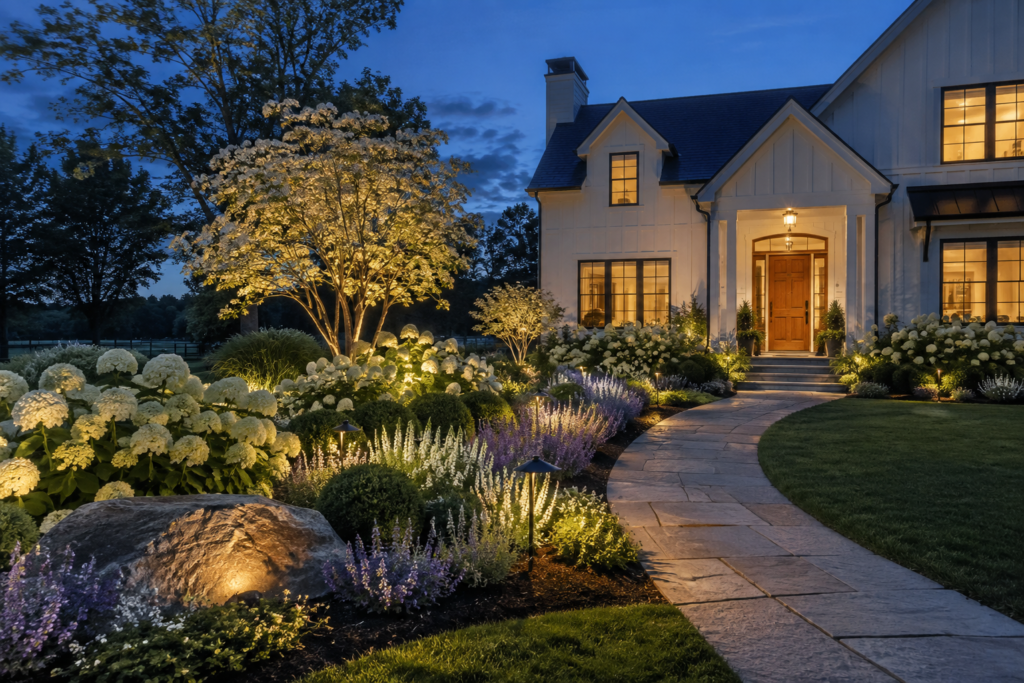
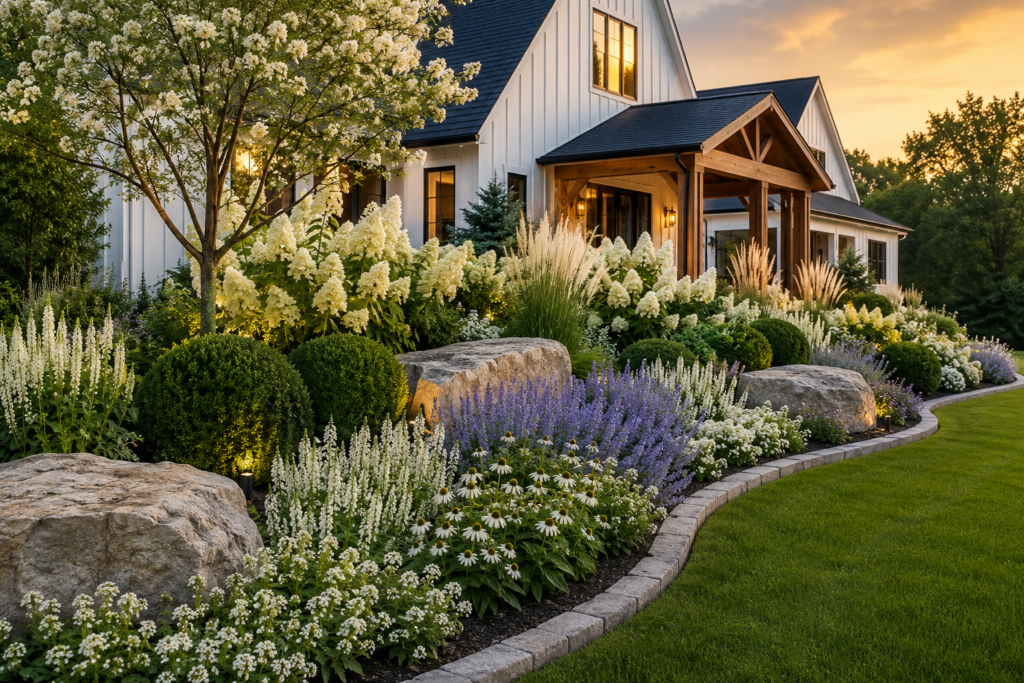
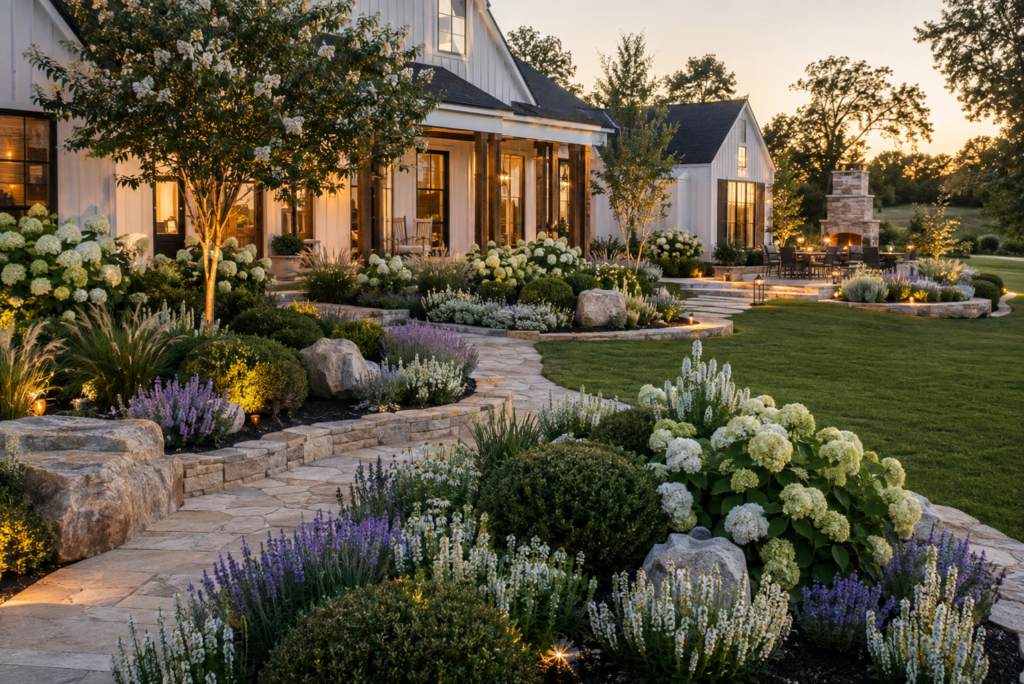
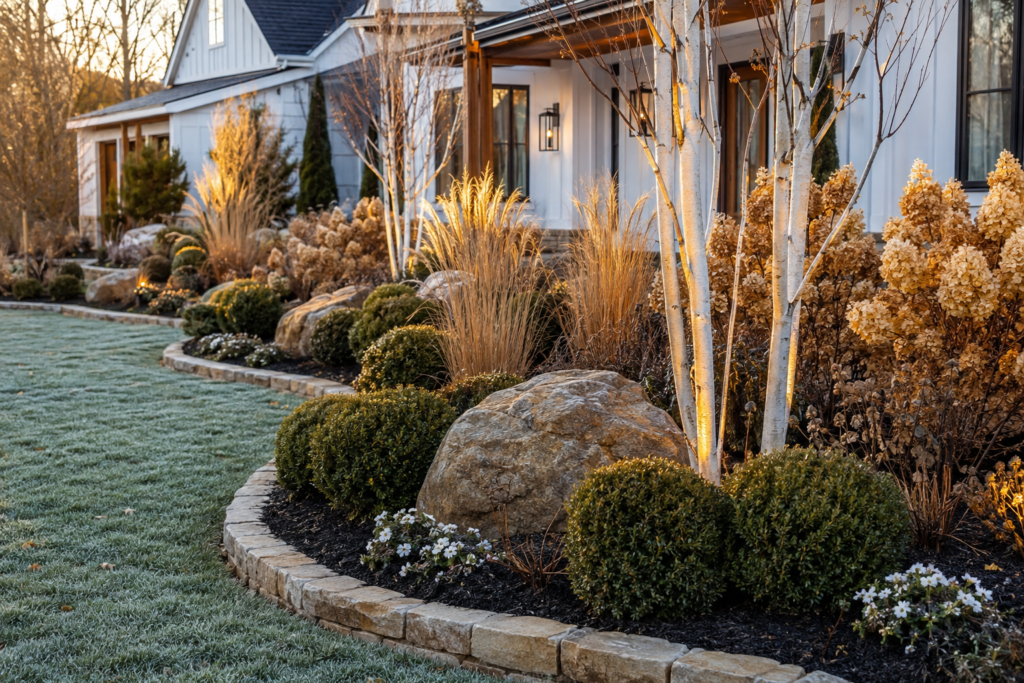
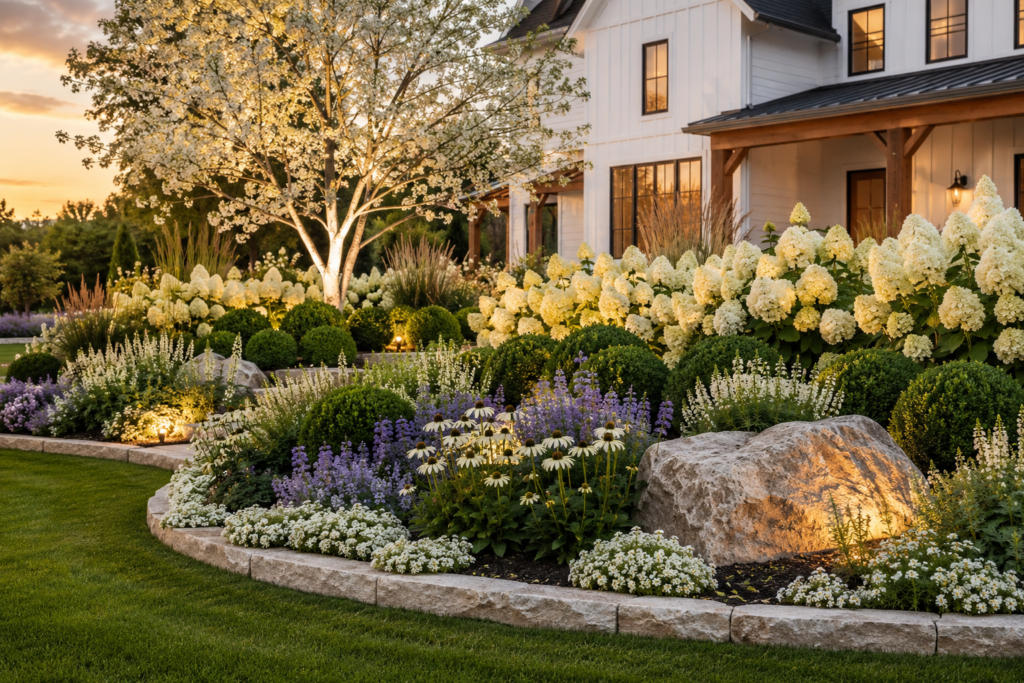
Luxury farmhouse flower bed ideas can transform an ordinary landscape into an elegant, professionally designed garden filled with layers, texture, and timeless curb appeal.
Luxury flower beds do far more than showcase beautiful blooms—they create the framework that gives your entire landscape elegance and structure.
Whether you’re designing a welcoming front entrance, bordering a winding garden path, or refreshing your home’s curb appeal, thoughtfully layered flower beds can completely transform the look of your property.
In this guide, you’ll discover 25 professionally inspired farmhouse flower bed ideas. These luxury farmhouse flower bed ideas combine timeless plants, natural stone, layered textures, and classic landscaping principles that become even more beautiful with age.
Layer Plants by Height for Professional Depth
Why You’ll Love It
The secret behind professionally designed flower beds isn’t simply choosing beautiful plants—it’s arranging them with intentional layers.
Tall shrubs create a stunning backdrop, medium-height perennials fill the middle, and low-growing flowers soften the front edge. This layered approach adds depth, texture, and movement while ensuring every plant has a chance to shine.
Instead of looking flat or overcrowded, your landscape feels balanced, lush, and thoughtfully designed from every angle.
🌿 Dream Backyard Principle
Every beautiful flower bed should have depth.
Professional landscapes guide your eye from the tallest plants in the back to the smallest blooms in the front, creating a rich, natural flow that feels effortless and inviting.
✨ Designer Insight
Landscape designers often think in three layers:
Background
Middle layer
Border layer
Repeating this structure throughout your landscape creates consistency while making even simple flower beds feel polished and magazine-worthy.
Recreate This Look
Limelight hydrangeas
Lavender catmint
White alyssum
Emerald Green boxwoods
Limestone edging
Premium hardwood mulch
Brass landscape lighting
Estimated Investment
$$–$$$
Layering plants requires thoughtful planning rather than a larger budget, making it one of the highest-impact improvements you can make to any flower bed.
Common Mistakes
Avoid planting everything at the same height.
Flat landscapes often feel unfinished because every plant competes for attention instead of complementing one another.
Why It Works
Layered flower beds create dimension, improve visibility, and naturally guide your eye through the landscape.
The result is a timeless garden that looks professionally designed from the very first season.
🌿 Build Your Dream Backyard
Beautiful flower beds are even more impactful when combined with these Dream Backyard Living guides:
Before planting, arrange the pots in your flower bed without digging. Step back 20–30 feet and adjust the layout until the tallest plants naturally frame the smaller ones.
🌟 Signature Quote
“Beautiful flower beds aren’t created by adding more plants—they’re created by giving every plant the perfect place to shine.”
🛍 Dream Backyard Living Curated Collection | Flower Bed Favorites
Garden Essentials
Limelight hydrangeas
Emerald Green boxwoods
Lavender catmint
White alyssum
Premium hardwood mulch
Tools
Bypass pruning shears
Garden kneeling pad
Drip irrigation kit
Limestone edging
Organic flower fertilizer
🌿 Dream Backyard Designer Pick
If you only borrow one technique from professional landscape designers, make it layering. Organizing plants by height instantly creates depth, elegance, and the lush, timeless appearance that defines luxury farmhouse gardens.
Repeat the Same Plants Throughout the Flower Bed
Why You’ll Love It
One of the biggest differences between an amateur flower bed and a professionally designed one is repetition.
Instead of planting one of every flower you love, repeat the same collection of shrubs and perennials throughout the landscape. Sweeping drifts of hydrangeas, evergreen boxwoods, and ornamental grasses create a calm, cohesive look that feels timeless rather than busy.
This simple design principle instantly makes your landscape appear larger, more elegant, and intentionally planned.
🌿 Dream Backyard Principle
Repetition creates harmony.
Luxury landscapes rely on a limited palette of exceptional plants repeated throughout the property.
When visitors see familiar colors, textures, and shapes from one flower bed to the next, the entire landscape feels connected and professionally designed.
✨ Designer Insight
Many landscape architects use only five to seven primary plants throughout an entire property.
These foundational plants are repeated in generous groupings, while seasonal flowers provide subtle accents instead of dominating the design.
This approach creates visual rhythm, simplifies maintenance, and gives the landscape a timeless, estate-quality appearance.
Recreate This Look
Limelight hydrangeas
Emerald Green boxwoods
Lavender catmint
Feather reed grass
White flowering dogwood trees
Natural limestone edging
Premium hardwood mulch
Plant in groups of three, five, or seven to create fuller, more natural-looking drifts.
Estimated Investment
$$–$$$$
Repeating the same plants can actually lower long-term costs by simplifying maintenance, reducing impulse purchases, and creating a more cohesive planting plan that grows beautifully over time.
Common Mistakes
Avoid filling flower beds with dozens of unrelated plant varieties.
Too much variety creates visual clutter and makes the landscape feel chaotic.
Instead, choose a timeless collection of plants and repeat them confidently throughout your property.
Why It Works
Repetition gives the eye a pattern to follow.
That consistency creates a peaceful, luxurious feeling while making every flower bed appear larger, fuller, and more professionally designed.
🌿 Build Your Dream Backyard
Beautiful flower beds become even more impactful when combined with these Dream Backyard Living guides:
When you’re shopping at the nursery, resist the temptation to buy “one of everything.” Purchase several of the same plant instead. As they mature together, they’ll create the lush, cohesive look seen in professionally designed landscapes.
🌟 Signature Quote
“The most elegant gardens don’t impress with endless variety—they inspire with beautiful repetition.”
🛍 Dream Backyard Living Curated Collection | Flower Bed Favorites
Garden Essentials
Limelight Hydrangeas
Emerald Green Boxwoods
Lavender Catmint
Premium Hardwood Mulch
Organic Flower Fertilizer
Tools
Bypass Pruning Shears
Garden Kneeling Pad
Drip Irrigation Kit
Limestone Edging
Garden Gloves
🌿 Dream Backyard Designer Pick
If you want your flower beds to look professionally designed, choose a handful of timeless plants and repeat them generously. This single design principle creates a landscape that feels calm, elegant, and far more expensive than one filled with dozens of unrelated varieties.
Anchor Every Flower Bed with White Hydrangeas
Why You’ll Love It
If there’s one plant that defines timeless farmhouse landscaping, it’s the white hydrangea.
Large clusters of creamy white blooms create an elegant focal point while blending beautifully with almost every architectural style. As the flowers mature, they gradually develop soft green and antique tones that extend their beauty well into fall.
Hydrangeas provide the structure that every professionally designed flower bed needs, making the surrounding plants feel even more cohesive and intentional.
🌿 Dream Backyard Principle
Every flower bed needs a focal plant.
Luxury landscapes are built around strong anchor plants that provide structure throughout the growing season.
White hydrangeas create visual stability while allowing colorful perennials and ornamental grasses to complement rather than compete with them.
✨ Designer Insight
Professional landscape designers frequently use Limelight Hydrangeas because they bloom reliably, tolerate a wide range of climates, and maintain outstanding structure from summer into fall.
By repeating hydrangeas throughout the property, they create a consistent rhythm that visually ties multiple flower beds together.
Recreate This Look
Limelight Hydrangeas
Emerald Green Boxwoods
White Salvia
Lavender Catmint
Feather Reed Grass
Natural Limestone Edging
Premium Hardwood Mulch
Space hydrangeas according to their mature size so they grow into full, rounded shrubs without overcrowding neighboring plants.
Estimated Investment
$$–$$$$
Hydrangeas are one of the best long-term investments for a luxury landscape.
Although they require patience while establishing, they reward homeowners with years of dramatic blooms and increasing beauty.
Common Mistakes
Avoid planting hydrangeas too close together.
Crowded shrubs compete for sunlight and airflow, reducing bloom production and increasing maintenance.
Always plan for their mature size rather than their size at planting.
Why It Works
Hydrangeas naturally become the visual centerpiece of the flower bed.
Their generous blooms create softness, elegance, and a timeless color palette that complements stone, wood, and black farmhouse accents beautifully.
🌿 Build Your Dream Backyard
Hydrangeas are one of the signature plants found throughout luxury farmhouse landscapes. Pair this idea with these Dream Backyard Living guides:
Plant hydrangeas where they’ll receive morning sun and afternoon shade in warmer climates. This helps the blooms stay bright and beautiful while reducing heat stress during the hottest part of the day.
🌟 Signature Quote
“A single hydrangea is beautiful—but a landscape filled with them becomes unforgettable.”
🛍 Dream Backyard Living Curated Collection | Flower Bed Favorites
Garden Essentials
Limelight Hydrangeas
Emerald Green Boxwoods
Lavender Catmint
Premium Hardwood Mulch
Organic Flower Fertilizer
Tools
Bypass Pruning Shears
Garden Kneeling Pad
Drip Irrigation Kit
Limestone Edging
Garden Gloves
🌿 Dream Backyard Designer Pick
If you want one plant to become the signature of your landscape, choose Limelight Hydrangeas. Their timeless white blooms, dependable performance, and elegant structure make them the perfect foundation for flower beds that look professionally designed and become more beautiful every year.
Frame Every Flower Bed with Evergreen Boxwoods
Why You’ll Love It
Beautiful flower beds shouldn’t lose their appeal when the flowers fade.
Evergreen boxwoods provide year-round structure, creating clean lines and elegant borders that make every flower bed look polished in every season. Their rich green foliage beautifully contrasts with white blooms while giving colorful perennials a strong architectural backdrop.
Whether covered in spring blossoms or winter snow, boxwoods keep your landscape looking intentional and beautifully maintained.
🌿 Dream Backyard Principle
Evergreens provide the structure that flowers cannot.
Luxury landscapes always include permanent elements that remain beautiful long after seasonal blooms disappear.
Boxwoods become the backbone of the garden, allowing flowering plants to change with the seasons while the landscape retains its elegant framework.
✨ Designer Insight
Professional landscape designers often install evergreen shrubs before adding flowering perennials.
They view evergreens as the “bones” of the landscape because they establish the overall shape, while flowers provide seasonal personality.
This approach ensures your garden always looks attractive—even during the dormant months.
Recreate This Look
Emerald Green boxwoods
Limelight hydrangeas
White salvia
Lavender catmint
Feather reed grass
Natural limestone edging
Premium hardwood mulch
Plant boxwoods in gentle curves rather than rigid straight lines to create a softer, more natural farmhouse appearance.
Estimated Investment
$$–$$$
Quality boxwoods are a long-term investment that pays dividends every season.
Their evergreen structure reduces the need for frequent redesigns while giving your flower beds a professionally landscaped appearance year-round.
Common Mistakes
Avoid planting boxwoods too close together.
Overcrowding increases maintenance and limits airflow, making shrubs more susceptible to disease.
Always space plants according to their mature width.
Why It Works
Boxwoods create order.
Their consistent shape frames colorful flowers, defines garden beds, and gives your landscape the timeless elegance found in professionally designed estates.
🌿 Build Your Dream Backyard
Evergreen structure is the foundation of every luxury landscape. Pair this idea with these Dream Backyard Living guides:
When pruning boxwoods, trim lightly two or three times during the growing season instead of making one heavy cut. Frequent light pruning encourages dense, healthy growth and maintains their crisp shape.
🌟 Signature Quote
“Flowers bring the color, but evergreens provide the timeless framework that makes a garden beautiful every day of the year.”
🛍 Dream Backyard Living Curated Collection | Flower Bed Favorites
Garden Essentials
Limelight Hydrangeas
Emerald Green Boxwoods
Lavender Catmint
Premium Hardwood Mulch
Organic Flower Fertilizer
Tools
Bypass Pruning Shears
Garden Kneeling Pad
Drip Irrigation Kit
Limestone Edging
Garden Gloves
🌿 Dream Backyard Designer Pick
If you want your flower beds to look professionally designed in every season, start with evergreen structure. Boxwoods create timeless elegance, highlight your flowering plants, and provide the year-round framework that gives luxury farmhouse landscapes their polished appearance.
Add Ornamental Grasses for Softness and Movement
Why You’ll Love It
Every luxury flower bed needs movement.
While shrubs provide structure and flowers deliver color, ornamental grasses add graceful motion that makes the entire landscape feel alive. Even the slightest breeze creates gentle movement, adding softness and elegance that static plantings simply can’t achieve.
The fine texture of ornamental grasses also contrasts beautifully with the large blooms of hydrangeas and the rounded shape of clipped boxwoods.
🌿 Dream Backyard Principle
Movement makes a landscape feel alive.
Luxury gardens don’t rely only on color.
They combine contrasting textures that respond naturally to the wind, creating a peaceful landscape that changes throughout the day without ever losing its timeless beauty.
✨ Designer Insight
Professional landscape designers almost always include ornamental grasses in their planting plans.
Feather Reed Grass is especially popular because its upright habit complements farmhouse architecture while remaining attractive from summer through winter. Its golden seed heads continue adding texture long after many flowers have faded.
Recreate This Look
Feather Reed Grass
Limelight Hydrangeas
Emerald Green Boxwoods
Lavender Catmint
White Salvia
Limestone Edging
Premium Hardwood Mulch
Repeat grasses throughout multiple flower beds to create rhythm across your landscape.
Estimated Investment
$$–$$$
Ornamental grasses are one of the most cost-effective ways to add year-round beauty.
Most varieties require minimal maintenance while providing months of texture, movement, and winter interest.
Common Mistakes
Avoid planting ornamental grasses individually throughout the landscape.
Instead, plant them in groups of three or five to create stronger visual impact and a more natural appearance.
Why It Works
Contrasting textures make every flower bed feel richer.
The soft, vertical lines of ornamental grasses balance rounded shrubs and flowering perennials, creating the layered elegance seen in professionally designed landscapes.
🌿 Build Your Dream Backyard
Beautiful textures make every landscape feel more luxurious. Pair this idea with these Dream Backyard Living guides:
Leave ornamental grasses standing through winter instead of cutting them back in the fall.
Their golden seed heads add beautiful texture, catch frost and snow, and provide interest long after the flowers have gone dormant.
🌟 Signature Quote
“The most beautiful gardens don’t stand still—they dance gently with every breeze.”
🛍 Dream Backyard Living Curated Collection | Flower Bed Favorites
Garden Essentials
Limelight Hydrangeas
Emerald Green Boxwoods
Feather Reed Grass
Premium Hardwood Mulch
Organic Flower Fertilizer
Tools
Bypass Pruning Shears
Garden Kneeling Pad
Drip Irrigation Kit
Limestone Edging
Garden Gloves
🌿 Dream Backyard Designer Pick
If your flower beds feel like they’re missing something, it’s often movement. A few thoughtfully placed ornamental grasses soften the landscape, add year-round texture, and create the graceful motion that gives luxury gardens their relaxed, timeless elegance.
Mix Evergreens with Perennials for Year-Round Beauty
Why You’ll Love It
The most beautiful flower beds remain attractive long after the flowers stop blooming.
By combining evergreen shrubs with flowering perennials, your landscape always has structure, color, and texture. Boxwoods provide the permanent framework while hydrangeas, salvia, catmint, and ornamental grasses add seasonal beauty that changes throughout the year.
The result is a flower bed that never feels empty, no matter the season.
🌿 Dream Backyard Principle
Build your flower beds around permanent structure.
Luxury landscapes always begin with plants that look beautiful every month of the year.
Seasonal flowers are then layered around that evergreen framework, creating a garden that’s constantly changing while never losing its elegant foundation.
✨ Designer Insight
Professional landscape designers often follow the 70/30 rule.
Approximately 70% of the landscape consists of permanent plants like evergreen shrubs, ornamental grasses, and flowering trees, while the remaining 30% is made up of seasonal perennials and accent flowers.
This balance creates year-round curb appeal while keeping maintenance manageable.
Recreate This Look
Emerald Green boxwoods
Limelight hydrangeas
White salvia
Lavender catmint
Feather reed grass
White flowering dogwood trees
Natural limestone edging
Repeat evergreen shrubs throughout the property to create a consistent architectural framework.
Estimated Investment
$$–$$$$
Investing in evergreen structure first creates a landscape that improves every year.
Once the framework is established, adding seasonal flowers becomes easier, less expensive, and far more impactful.
Common Mistakes
Avoid relying entirely on flowering plants.
During the off-season, flower beds without evergreen structure often look sparse and unfinished.
Instead, let evergreen shrubs provide the foundation while flowers supply seasonal color.
Why It Works
Evergreens give the landscape permanence.
Combined with colorful perennials, they create continuous visual interest that feels lush, balanced, and professionally designed throughout every season.
🌿 Build Your Dream Backyard
Beautiful flower beds begin with a strong foundation. Pair this idea with these Dream Backyard Living guides:
Before buying flowers, decide where your evergreen shrubs will go first.
Once the permanent structure is in place, filling the remaining spaces with seasonal color becomes much easier—and the finished design will feel far more intentional.
🌟 Signature Quote
“The most timeless flower beds are built on a foundation that stays beautiful long after the last bloom has faded.”
🛍 Dream Backyard Living Curated Collection | Flower Bed Favorites
Garden Essentials
Limelight Hydrangeas
Emerald Green Boxwoods
Feather Reed Grass
Lavender Catmint
Organic Flower Fertilizer
Tools
Bypass Pruning Shears
Garden Kneeling Pad
Drip Irrigation Kit
Limestone Edging
Garden Gloves
🌿 Dream Backyard Designer Pick
If you want flower beds that look incredible every month of the year, invest in evergreen structure first. A beautiful framework of boxwoods, flowering shrubs, and ornamental grasses allows seasonal flowers to shine while ensuring your landscape never loses its polished, luxurious appearance.
Define Flower Beds with Natural Stone Edging
Why You’ll Love It
The most beautiful flower beds remain attractive long after the flowers stop blooming.
By combining evergreen shrubs with flowering perennials, your landscape always has structure, color, and texture. Boxwoods provide the permanent framework while hydrangeas, salvia, catmint, and ornamental grasses add seasonal beauty that changes throughout the year.
The result is a flower bed that never feels empty, no matter the season.
🌿 Dream Backyard Principle
Build your flower beds around permanent structure.
Luxury landscapes always begin with plants that look beautiful every month of the year.
Seasonal flowers are then layered around that evergreen framework, creating a garden that’s constantly changing while never losing its elegant foundation.
✨ Designer Insight
Professional landscape designers often follow the 70/30 rule.
Approximately 70% of the landscape consists of permanent plants like evergreen shrubs, ornamental grasses, and flowering trees, while the remaining 30% is made up of seasonal perennials and accent flowers.
This balance creates year-round curb appeal while keeping maintenance manageable.
Recreate This Look
Emerald Green boxwoods
Limelight hydrangeas
White salvia
Lavender catmint
Feather reed grass
White flowering dogwood trees
Natural limestone edging
Repeat evergreen shrubs throughout the property to create a consistent architectural framework.
Estimated Investment
$$–$$$$
Investing in evergreen structure first creates a landscape that improves every year.
Once the framework is established, adding seasonal flowers becomes easier, less expensive, and far more impactful.
Common Mistakes
Avoid relying entirely on flowering plants.
During the off-season, flower beds without evergreen structure often look sparse and unfinished.
Instead, let evergreen shrubs provide the foundation while flowers supply seasonal color.
Why It Works
Evergreens give the landscape permanence.
Combined with colorful perennials, they create continuous visual interest that feels lush, balanced, and professionally designed throughout every season.
🌿 Build Your Dream Backyard
Beautiful flower beds begin with a strong foundation. Pair this idea with these Dream Backyard Living guides:
Before buying flowers, decide where your evergreen shrubs will go first.
Once the permanent structure is in place, filling the remaining spaces with seasonal color becomes much easier—and the finished design will feel far more intentional.
🌟 Signature Quote
“The most timeless flower beds are built on a foundation that stays beautiful long after the last bloom has faded.”
🛍 Dream Backyard Living Curated Collection | Flower Bed Favorites
Garden Essentials
Limelight Hydrangeas
Emerald Green Boxwoods
Feather Reed Grass
Lavender Catmint
Organic Flower Fertilizer
Tools
Bypass Pruning Shears
Garden Kneeling Pad
Drip Irrigation Kit
Limestone Edging
Garden Gloves
How to Make Luxury Farmhouse Flower Bed Ideas Look Professionally Designed
🌿 Dream Backyard Designer Pick
If you want flower beds that look incredible every month of the year, invest in evergreen structure first. A beautiful framework of boxwoods, flowering shrubs, and ornamental grasses allows seasonal flowers to shine while ensuring your landscape never loses its polished, luxurious appearance.
Why You’ll Love It
One of the fastest ways to make a flower bed look professionally designed is to think in large drifts instead of individual plants.
Rather than scattering flowers throughout the garden, group the same variety together in generous sweeps. Large masses of hydrangeas, catmint, and ornamental grasses create bold visual impact while giving your landscape a calm, intentional appearance.
This simple technique is one of the defining characteristics of luxury estate gardens.
🌿 Dream Backyard Principle
Plant generously—not randomly.
Luxury landscapes create beauty through abundance.
Repeating groups of the same plant allows each variety to make a statement while creating visual rhythm throughout the landscape.
✨ Designer Insight
Professional designers rarely install one or two of a plant.
Instead, they purchase enough to create broad, flowing masses that naturally guide the eye through the landscape.
Large drifts also reduce visual clutter and make maintenance much simpler over time.
Although mass planting requires purchasing more of the same plant initially, it creates a far more cohesive landscape that often requires fewer replacements and less redesign over time.
Common Mistakes
Avoid buying one of every flower that catches your eye.
A landscape filled with isolated plants often feels busy and disconnected.
Instead, choose a limited palette and repeat it confidently in generous groupings.
Why It Works
Large drifts simplify the landscape.
They create bold focal points, improve visual flow, and establish the calm elegance that’s found in professionally designed farmhouse gardens.
🌿 Build Your Dream Backyard
Mass plantings look even more impressive when combined with these Dream Backyard Living guides:
When visiting your local nursery, buy plants in odd numbers—three, five, or seven—and plant them close enough to grow together into one beautiful drift instead of several isolated specimens.
🌟 Signature Quote
“Luxury landscapes aren’t filled with more plants—they’re filled with more purpose.”
🛍 Dream Backyard Living Favorites
Use your existing affiliate links for:
🌿 Limelight Hydrangeas
🌸 Lavender Catmint
🌼 White Salvia
🌾 Feather Reed Grass
🌱 Espoma Holly-tone Fertilizer
✂️ Fiskars Titanium Bypass Pruning Shears
🪨 EasyFlex No-Dig Landscape Edging Kit
💧 Rain Bird Drip Irrigation Kit
🚿 Giraffe Tools Retractable Hose Reel
🧤 Leather Gardening Gloves
🌿 Dream Backyard Designer Pick
If you want your flower beds to look like they belong on a luxury estate, stop thinking about individual plants and start thinking in sweeping drifts. Repeating generous groupings creates the timeless elegance that makes professionally designed landscapes feel peaceful, cohesive, and unforgettable.
Include Flowering Shrubs for Four Seasons of Interest
Why You’ll Love It
The most memorable flower beds don’t peak for just a few weeks—they offer something beautiful in every season.
By combining flowering shrubs, evergreen structure, ornamental grasses, and long-blooming perennials, your landscape remains colorful and inviting from early spring through winter. White dogwoods welcome spring, hydrangeas dominate summer, ornamental grasses add fall texture, and evergreen boxwoods provide winter structure.
Instead of disappearing after one bloom cycle, your landscape continues evolving with every season.
🌿 Dream Backyard Principle
Design for all four seasons—not just spring.
Luxury landscapes are never built around a single moment of beauty.
Every plant should contribute something unique throughout the year, creating continuous interest no matter the season.
✨ Designer Insight
Professional landscape designers intentionally stagger bloom times.
Early flowering trees transition into hydrangeas, which give way to ornamental grasses and colorful foliage before evergreens become the stars of the winter landscape.
This thoughtful sequence keeps gardens looking complete every month of the year.
If every new addition contributes beauty during a different time of year, your flower beds will always have something worth admiring.
🌟 Signature Quote
“The finest gardens aren’t remembered for one perfect season—they’re loved because every season offers something beautiful to discover.”
🛍 Dream Backyard Living Favorites
Use your existing affiliate links for:
🌿 Limelight Hydrangeas
🌱 Espoma Holly-tone Fertilizer
✂️ Fiskars Titanium Bypass Pruning Shears
💧 Rain Bird Drip Irrigation Kit
🚿 Giraffe Tools Retractable Hose Reel
🧤 Leather Gardening Gloves
🪨 EasyFlex No-Dig Landscape Edging Kit
🪴 Garden Kneeling Pad
🌱 Premium Hardwood Mulch
🌾 Feather Reed Grass
🌿 Dream Backyard Designer Pick
A truly luxurious flower bed never has an “off season.” By layering flowering shrubs, evergreen structure, ornamental grasses, and dependable perennials, you’ll create a landscape that welcomes you home with beauty every month of the year.
Create Curved Flower Beds That Feel Natural
Why You’ll Love It
The shape of your flower bed is just as important as the plants growing inside it.
Gentle curves soften the architecture of a home, guide the eye naturally through the landscape, and create a relaxed elegance that feels timeless. Rather than stopping abruptly at straight lines and sharp corners, curved beds encourage movement while allowing plants to flow together more naturally.
It’s a simple design choice that instantly gives your landscape a professionally planned appearance.
🌿 Dream Backyard Principle
Nature rarely grows in straight lines.
Luxury landscapes borrow inspiration from nature.
Soft curves create a sense of movement and balance while helping flower beds blend seamlessly into the surrounding lawn and garden.
✨ Designer Insight
Professional landscape designers often begin with sweeping curves before selecting a single plant.
A beautifully shaped flower bed creates visual interest all year long—even in winter when many plants are dormant. The planting simply becomes the finishing touch.
Wide, gentle curves generally age much better than tight, winding shapes, which can become difficult to mow and maintain.
Use a garden hose to lay out the shape of your flower bed before digging.
Walk around it from different angles and make adjustments until the curves feel balanced and natural. This simple trick is used by professional landscape designers to visualize the finished design.
🌟 Signature Quote
“The most elegant flower beds don’t force your eyes to stop—they gently invite you to keep exploring.”
🛍 Dream Backyard Living Favorites
🌿 Limelight Hydrangeas
🟩 Emerald Green Boxwoods
🌾 Feather Reed Grass
🌱 Espoma Holly-tone Fertilizer
✂️ Fiskars Titanium Bypass Pruning Shears
🪨 EasyFlex No-Dig Landscape Edging Kit
💧 Rain Bird Drip Irrigation Kit
🚿 Giraffe Tools Retractable Hose Reel
🧤 Leather Gardening Gloves
🪴 Garden Kneeling Pad
Add Lavender and Catmint for a Soft Farmhouse Border
Why You’ll Love It
One of the easiest ways to make a luxury farmhouse flower bed feel established and professionally designed is to soften its edges.
Lavender and catmint create that effortless, slightly overflowing look that makes a garden feel as though it has been growing beautifully for years. Their soft purple-blue flowers look especially elegant against white hydrangeas, deep green boxwoods, natural stone, and warm wood accents.
Instead of ending abruptly at the lawn or walkway, the flower bed gently spills toward the edge—creating the relaxed elegance that works so beautifully with farmhouse landscaping.
🌿 Dream Backyard Principle
Let structured landscaping have one beautifully imperfect layer.
Luxury farmhouse gardens work because they balance order with softness.
Hydrangeas and boxwoods establish the structure. Natural stone defines the flower bed. Then looser perennials such as catmint and lavender soften those harder lines.
That contrast keeps the landscape from looking overly formal while still feeling intentional and polished.
✨ Designer Insight
When designing a border, don’t space every perennial like an individual specimen.
For a fuller designer look, repeat the same variety in generous groups and allow the plants to grow close enough that their mature foliage visually connects.
Try creating a simple three-level planting:
Back: White hydrangeas Middle: Evergreen boxwoods or ornamental grasses Front: Lavender or catmint
The result is a layered flower bed with height, structure, color, and softness.
For larger beds, repeat the combination several times rather than introducing a different plant every few feet.
Recreate This Look
White Limelight hydrangeas
Evergreen boxwoods
Lavender
Catmint
White salvia
Feather reed grass
Natural limestone edging
Dark hardwood mulch
Warm landscape lighting
Allow some of the catmint or lavender to soften the stone edge rather than keeping every plant perfectly contained behind it.
Estimated Investment
$$–$$$
This is one of the more affordable ways to make an existing farmhouse flower bed look professionally landscaped.
If you already have larger anchor shrubs, adding repeated groups of lavender or catmint along the front can completely change the appearance without redesigning the entire bed.
Perennials can also become a better value over time as established plants mature and fill their allotted space.
Common Mistakes
Avoid planting a single lavender or catmint plant here and there throughout the flower bed.
Scattered plants can create a spotty appearance rather than the lush sweep we’re trying to achieve.
Also pay attention to the growing conditions of the particular plants you choose. Lavender generally prefers excellent drainage and plenty of sun, while the best plant choice will ultimately depend on your climate, soil, sunlight, and specific cultivar.
The goal isn’t to force a particular plant into every landscape.
It’s to recreate the soft, repeating border effect with plants suited to your property.
Why It Works
Soft perennial borders create an important transition between the structured flower bed and the surrounding lawn, walkway, or patio.
They also introduce another layer of color and texture without competing with your main focal plants.
Against white farmhouse architecture, the combination is especially beautiful:
creamy white blooms + deep evergreen foliage + soft lavender-purple flowers + natural stone.
It’s sophisticated without feeling formal—and luxurious without feeling overdesigned.
🌿 Build Your Dream Backyard
Continue the look beyond your flower beds with the 25 Luxury Farmhouse Landscaping Ideas That Make Every Backyard Feel Like a Private Resort guide.
Don’t judge a perennial border by how sparse it looks on planting day.
Design around the mature width of each plant. Giving your perennials appropriate room to grow can produce the lush, overlapping effect you want without creating an overcrowded bed later.
🌟 Signature Quote
“The most beautiful farmhouse gardens balance strong structure with flowers that are allowed to soften the edges.”
🛍 Dream Backyard Living Curated Collection | Flower Bed Favorites
Garden Essentials
Lavender plants
Catmint
White salvia
Organic perennial fertilizer
Premium hardwood mulch
Garden Tools
Bypass pruning shears
Garden kneeling pad
Drip-irrigation kit
Garden gloves
Soil moisture meter
Important: when you paste this one into WordPress, don’t paste our old parenthetical note about adding affiliate links later. Those drafting instructions are currently visible in several of Ideas #1–10 on the published page and need to be removed.
🌿 Dream Backyard Designer Pick
If your farmhouse flower beds already have beautiful shrubs but still feel a little stiff or unfinished, add a repeating border of soft perennials. That single layer can transform hard edges into the relaxed, established look that makes professionally designed gardens feel so inviting.
SEO bonus: This section naturally strengthens the article around phrases such as farmhouse flower bed, luxury farmhouse garden, professionally landscaped, flower bed border, and farmhouse landscaping without awkward keyword stuffing.
Next is #12: Use White Flowers for a Timeless Farmhouse Color Palette.
Use White Flowers for a Timeless Farmhouse Color Palette
Why You’ll Love It
Few landscaping choices feel as timeless and luxurious as a flower bed built around layers of white blooms and rich green foliage.
White flowers look especially beautiful against farmhouse architecture because they echo white siding, painted brick, limestone, and other light exterior finishes without making the landscape feel overly coordinated.
The secret is variety.
Instead of filling the entire bed with one white flower, combine different heights, bloom shapes, foliage textures, and shades of white. Large hydrangea blossoms can provide drama while smaller flowering perennials create softness near the front.
The finished garden feels peaceful, elegant, and intentionally designed.
🌿 Dream Backyard Principle
Limit the color palette and increase the texture.
Professional landscapes don’t always need more color.
Sometimes they need more layers.
A restrained white-and-green palette allows the architecture, stonework, pathways, and individual plant forms to become part of the design.
Think:
white blooms + deep green foliage + natural stone + warm wood + soft landscape lighting.
It’s one of the easiest combinations to carry throughout an entire luxury farmhouse property.
✨ Designer Insight
Use at least three different plant heights when creating a mostly white flower bed.
For example:
Back Layer: Large white hydrangeas or flowering shrubs
Middle Layer: Boxwoods, white roses, white salvia, or ornamental grasses
Front Layer: White annuals, alyssum, creeping phlox, or other low-growing flowers suited to your climate
Then repeat those plants throughout the bed.
Repetition makes the garden feel professionally planned rather than randomly planted.
Recreate This Look
Consider combining:
White hydrangeas
Evergreen boxwoods
White roses
White salvia
White coneflowers
White alyssum
Ornamental grasses
Natural limestone edging
Dark mulch
Warm landscape lighting
You don’t need every plant on this list.
Choose a few varieties that thrive in your growing conditions and repeat them generously.
Estimated Investment
$$–$$$$
A white farmhouse flower bed can work at almost any budget.
For an affordable transformation, keep existing shrubs and introduce groups of white flowering perennials around them.
For a more dramatic landscape renovation, invest in mature hydrangeas, evergreen structure, stone edging, irrigation, and landscape lighting.
The advantage is that this style doesn’t depend on trendy plants or unusual colors to look expensive.
Common Mistakes
The biggest mistake is assuming that all white flowers automatically work together.
Pay attention to bloom time, mature plant size, sunlight requirements, water needs, and foliage.
You also don’t want every plant blooming at exactly the same height.
Without variation, an all-white garden can become visually flat.
Use foliage and structure to create contrast even when the flower colors remain similar.
Why It Works
A limited white-and-green palette gives the eye somewhere to rest.
Instead of competing colors pulling attention in different directions, you notice:
the architecture of the plants, the curve of the flower bed, the texture of the stone, and the layers of foliage.
White flowers can also become especially striking in the softer light of early morning and evening.
The result is landscaping that feels understated during the day and almost magical around sunset.
🌿 Build Your Dream Backyard
Continue the white-and-green palette throughout the property with your Luxury Farmhouse Landscaping Ideas.
If an entirely white garden feels too restrictive, introduce one soft accent color.
Pale lavender, dusty blue, or blush pink can add just enough variation without losing the sophisticated farmhouse palette.
Keep the accent limited and repeat it several times rather than scattering many different colors throughout the bed.
🌟 Signature Quote
“Luxury doesn’t always come from adding more color. Sometimes the most unforgettable gardens are the ones that know exactly when to stop.”
🛍 Dream Backyard Living Curated Collection | White Garden Favorites
This section is ideal for affiliate products such as:
White flowering plant seeds
Decorative garden edging
Drip irrigation kits
Premium pruning shears
Garden gloves
Soil moisture meters
Outdoor landscape lights
Decorative farmhouse planters
🌿 Dream Backyard Designer Pick
Start with white hydrangeas and evergreen boxwoods if you want to recreate this look gradually. They establish the major white-and-green structure first, and smaller flowering plants can be layered around them over time.
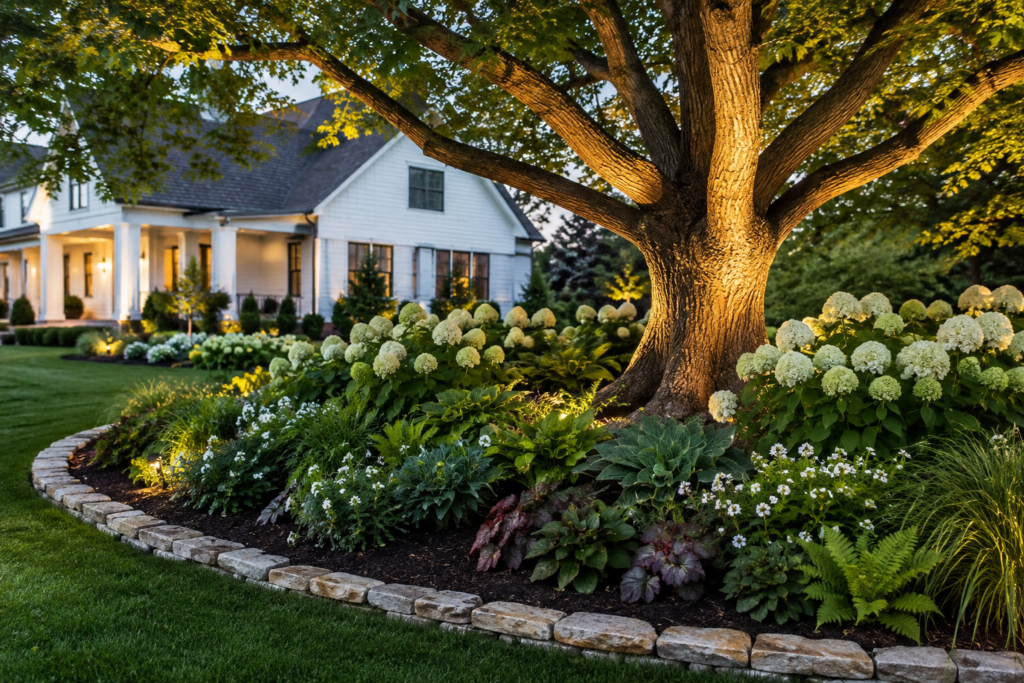
Plant Flower Beds Around Mature Trees
Why You’ll Love It
Mature trees are one of the most valuable features a farmhouse landscape can have—and the right flower bed can turn a beautiful tree into a true landscape focal point.
Instead of leaving an isolated tree surrounded by lawn, create a generous planting bed around it using layered shrubs, shade-tolerant perennials, ornamental grasses, and soft groundcovers.
The result feels established and intentional, especially on larger farmhouse properties where individual trees can otherwise look disconnected from the rest of the landscaping.
The key is making the bed feel natural rather than like a tiny circle cut around the trunk.
🌿 Dream Backyard Principle
Design around the tree’s natural scale.
A large mature tree needs a landscape bed substantial enough to visually balance its canopy.
Instead of creating a small mulch ring, use a broad, softly curved bed that connects the tree to surrounding landscaping.
This creates the expansive, established feeling often found in professionally designed estate landscapes.
✨ Designer Insight
Let the existing tree determine the shape of the bed.
Create broad curves rather than a perfect circle, and consider extending the bed toward a nearby walkway, porch, driveway, or existing planting area.
Then build layers underneath:
Upper Layer: The mature tree canopy
Back/Middle Layer: Shade-tolerant shrubs and ornamental grasses
Lower Layer: Hostas, heuchera, ferns, or other perennials appropriate for your growing conditions
Edge Layer: Low-growing groundcovers or a restrained stone border
This creates considerably more visual depth than simply surrounding the trunk with mulch.
Recreate This Look
Depending on the amount of sunlight beneath your tree, consider:
White hydrangeas suited to the site’s light conditions
Hostas
Heuchera
Ferns
Shade-tolerant ornamental grasses
White flowering perennials
Natural limestone edging
Dark mulch
Low-voltage uplighting
Keep the planting palette relatively simple and repeat varieties rather than filling the bed with dozens of unrelated plants.
Estimated Investment
$$–$$$$
If the tree already exists, this can be a surprisingly affordable landscape transformation.
A DIY bed with mulch and smaller perennials may cost relatively little, while a large professionally installed bed with mature shrubs, natural stone edging, irrigation, and landscape lighting can become a significant landscape feature.
Start with the shape and structure first. Smaller plants can fill in as the garden matures.
Common Mistakes
One of the biggest mistakes is creating a tiny circular flower bed around a very large tree.
It can make both the tree and landscaping feel disconnected from the property.
More importantly, avoid piling soil or mulch against the tree trunk. The root flare should remain visible, and major roots shouldn’t be damaged simply to create a flower bed.
Also remember that established trees compete with new plants for water, nutrients, and sunlight, so choose plants appropriate for those conditions.
Why It Works
Mature trees already provide something money can’t quickly recreate: scale, age, shade, and architectural presence.
Thoughtful landscaping underneath them makes the entire property feel more established.
It also creates another opportunity to repeat materials from elsewhere in the landscape—such as limestone edging, white flowers, ornamental grasses, and warm lighting—helping the property feel like one cohesive design.
🌿 Build Your Dream Backyard
Carry the same layered approach throughout the property with your Luxury Farmhouse Landscaping Ideas.
Add a discreet uplight at the base of a particularly beautiful mature tree.
At night, the illuminated trunk and canopy add height and drama to the landscape while the surrounding flower bed creates a softer foreground.
One beautifully illuminated tree can make an entire backyard feel more luxurious.
🌟 Signature Quote
“The most beautiful farmhouse landscapes don’t compete with mature trees—they make them part of the architecture.”
🛍 Dream Backyard Living Curated Collection | Tree Garden Favorites
This section is a natural place for affiliate products such as:
Low-voltage tree uplights
Drip-irrigation kits
Garden edging
Pruning shears
Garden gloves
Soil moisture meter
Soaker hose
Landscape fabric staples
🌿 Dream Backyard Designer Pick
Low-voltage uplighting would be my featured product for this idea. It gives readers an inexpensive way to recreate one of the most dramatic elements of a professionally landscaped tree bed without replacing any plants.
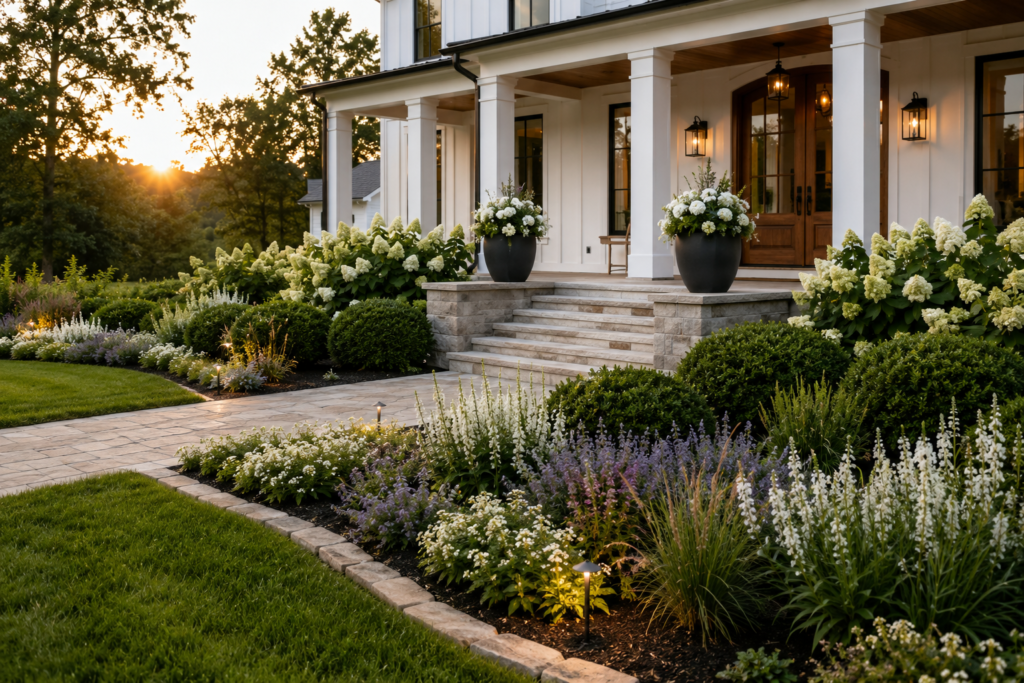
Create a Statement Flower Bed Around the Front Porch
Why You’ll Love It
The landscaping around your front porch has an outsized influence on how polished the entire home feels.
Instead of treating porch flower beds as narrow strips of plants against the foundation, give them enough depth, height, and repetition to become part of the home’s architecture.
A luxurious farmhouse porch might be framed by billowing white hydrangeas, sculpted evergreen boxwoods, soft flowering perennials, and ornamental grasses—all layered beneath warm porch lighting and oversized planters.
The result is welcoming without looking overly formal.
🌿 Dream Backyard Principle
Frame the architecture instead of hiding it.
Foundation landscaping should enhance the home’s strongest features—not cover them.
Use taller plantings around blank walls and corners while keeping plants lower near windows, steps, and architectural details you want to emphasize.
Think of the flower bed as a soft frame around the porch.
✨ Designer Insight
Start with the porch itself and work outward.
For a classic luxury farmhouse look, try:
Back Layer: White hydrangeas or flowering shrubs
Structural Layer: Rounded boxwoods or compact evergreens
Soft Middle Layer: White salvia, catmint, lavender, or ornamental grasses
Front Layer: Low-growing flowering perennials spilling slightly toward the stone edging
Then repeat some of the same flowers on the porch in oversized planters.
That visual repetition connects the landscaping to the house.
Recreate This Look
White Limelight hydrangeas
Rounded evergreen boxwoods
White salvia
Lavender or catmint
Soft ornamental grasses
Low-growing white flowers
Large black or aged-stone porch planters
Natural limestone edging
Dark mulch
Warm pathway and landscape lighting
Keep the overall palette restrained. White, green, soft lavender, natural stone, black accents, and warm wood are enough to create an incredibly sophisticated entrance.
Estimated Investment
$$–$$$$
This look can be created gradually.
If the existing porch beds have healthy foundation plants, keep them and concentrate on adding layers and repetition.
For a larger transformation, widening undersized beds and adding mature shrubs, stone edging, irrigation, oversized planters, and landscape lighting can make the front porch feel completely redesigned.
Because this landscaping is highly visible from the street, it’s one of the areas where I’d prioritize the landscaping budget.
Common Mistakes
Avoid planting a perfectly straight row of identical shrubs against the foundation.
That can make a farmhouse landscape feel stiff and builder-basic rather than established.
Another common mistake is making the bed too narrow.
Large farmhouse architecture often needs deeper landscaping to create the right proportions.
And don’t let mature shrubs cover windows, porch columns, steps, or other beautiful architectural details.
Why It Works
The front porch is already one of the home’s strongest focal points.
Layered flower beds make the eye travel naturally from:
lawn → flowers → porch → front door.
That progression creates depth and makes even a relatively simple farmhouse exterior feel much more substantial.
It also connects beautifully with landscaping along the front walkway and entry.
🌿 Build Your Dream Backyard
Continue the landscaping toward the entrance with your Luxury Farmhouse Front Entry Ideas.
Stand at the street or end of the driveway before deciding where the largest shrubs should go.
Landscaping that looks enormous when you’re standing beside it can look surprisingly small against the scale of a house.
Designing from the primary viewing distance helps you choose proportions that make the entire front elevation feel balanced.
🌟 Signature Quote
“A beautiful front porch welcomes you to the house. Beautiful landscaping makes the entire home feel welcoming before you ever reach the steps.”
🛍 Dream Backyard Living Curated Collection | Front Porch Flower Bed Favorites
This is a strong affiliate section because readers can recreate pieces of the look without hiring a landscaper:
Oversized black outdoor planters
Low-voltage landscape lights
Drip-irrigation kit
Garden edging
Pruning shears
Soil moisture meter
Garden gloves
Decorative watering wand
🌿 Dream Backyard Designer Pick
Oversized black planters are my favorite finishing touch for this look. Place a matching pair near the porch steps or front door and fill them with plants that repeat the colors already growing in the flower beds.
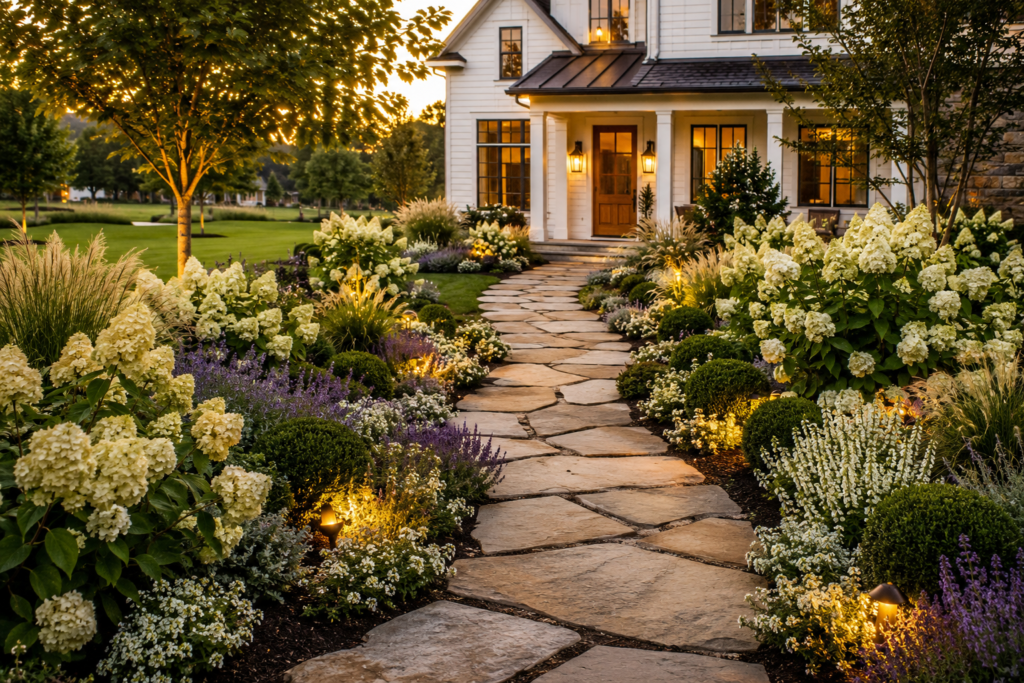
Line Walkways with Layered Flower Beds
Why You’ll Love It
A beautiful walkway becomes dramatically more impressive when the landscaping feels like it was designed with the path rather than added around it afterward.
Instead of leaving lawn directly beside a stone or concrete walkway, create generous flower beds that follow its curves and lead the eye toward the house, porch, garden, or backyard entertaining area.
For the luxury farmhouse look, combine large flowering shrubs, evergreen structure, airy perennials, ornamental grasses, and low-growing flowers that gently soften the walkway’s edges.
The pathway becomes more than a way to get from one place to another—it becomes an experience.
🌿 Dream Backyard Principle
Use landscaping to create a destination.
Great garden paths make you curious about what’s at the other end.
Rather than revealing everything at once, use layered flower beds to create movement, rhythm, and subtle focal points along the walkway.
Repeat a few signature plants throughout the beds so the eye naturally follows them toward the destination.
✨ Designer Insight
Avoid planting identical rows on both sides of the walkway.
Luxury landscaping often looks more natural when the two sides coordinate without perfectly mirroring one another.
For example:
One Side: Large white hydrangeas + boxwoods + catmint
Opposite Side: Ornamental grasses + white salvia + smaller hydrangeas + catmint
The plants repeat, but their arrangement changes slightly.
This creates cohesion without making the walkway feel overly formal.
Recreate This Look
Consider layering:
White Limelight hydrangeas
Rounded evergreen boxwoods
White salvia
Lavender or catmint
Feather reed grass
Low-growing white perennials
Natural limestone or flagstone
Dark mulch
Warm pathway lights
Allow selected low-growing plants to slightly soften the walkway edge while keeping enough clear space for comfortable walking.
Estimated Investment
$$–$$$$
The cost depends heavily on the length of the walkway and whether you’re landscaping an existing path or installing a new one.
If the walkway is already in place, smaller perennials and young shrubs can create an affordable starting point.
For the full estate-style look, invest first in the shape of the beds and larger structural plants, then fill gaps with smaller perennials as the landscape develops.
Common Mistakes
Don’t make the planting beds so narrow that you can only fit a single row of plants.
That tends to create a border rather than the lush, layered landscape we’re after.
Also avoid placing mature plants where they’ll constantly spill too far onto the walking surface.
A little softness is beautiful.
Having to fight through hydrangeas every time you walk to the front door isn’t.
Check mature plant dimensions before deciding how close each plant should be to the path.
Why It Works
Walkway flower beds create a visual connection between different parts of the property.
Instead of seeing:
house + walkway + lawn + random landscaping
you begin seeing one cohesive landscape.
Repeating hydrangeas, boxwoods, grasses, and flowering perennials along the path also gives you an easy way to carry the same design language from the front entry into the backyard.
🌿 Build Your Dream Backyard
For the pathway itself, pair this landscaping with your Luxury Farmhouse Garden Path Ideas.
Place pathway lights among the plants rather than creating a perfectly straight runway of fixtures.
The goal is to softly illuminate the walking surface and surrounding landscaping without making the fixtures themselves the focal point.
At night, pools of warm light among hydrangeas and ornamental grasses can make a simple walkway feel remarkably high-end.
🌟 Signature Quote
“A thoughtfully landscaped path doesn’t simply show you where to walk—it makes you want to see where it leads.”
🛍 Dream Backyard Living Curated Collection | Garden Walkway Favorites
This section gives us several natural affiliate opportunities:
Low-voltage pathway lights
Solar landscape lights
Drip-irrigation kit
Garden edging
Bypass pruning shears
Soaker hose
Garden gloves
Soil moisture meter
🌿 Dream Backyard Designer Pick
Warm low-voltage pathway lighting is my pick for this design. It’s one of the few additions that improves the walkway twice—adding practical visibility at night while also highlighting the surrounding landscaping.
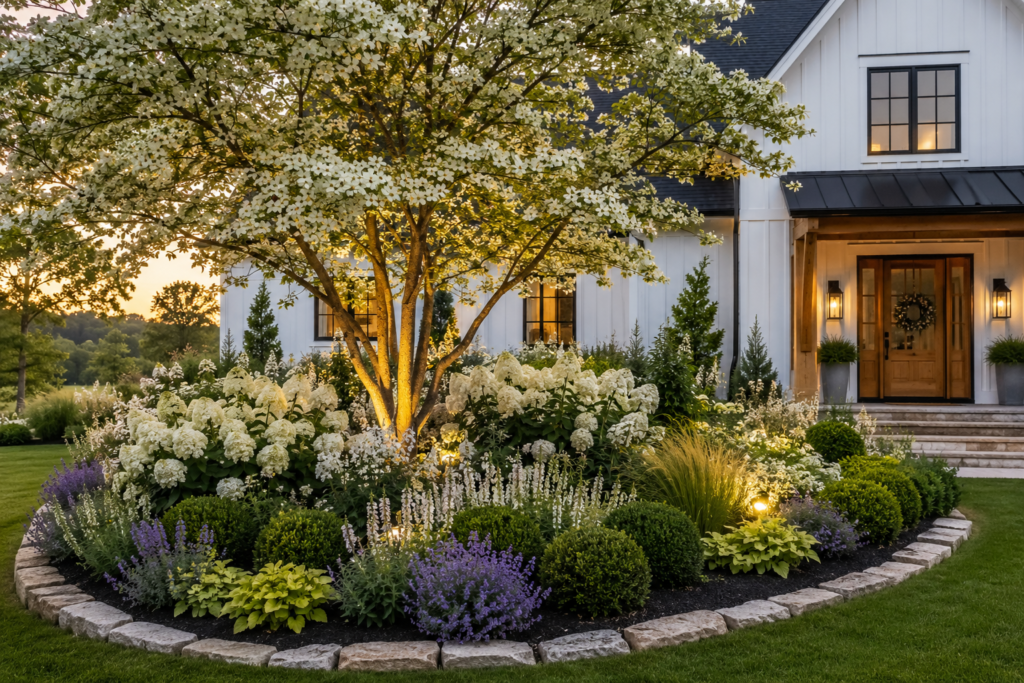
Add Flowering Dogwoods for Vertical Interest
Why You’ll Love It
Flower beds become dramatically more interesting when the landscaping doesn’t stop at shrub height.
A beautiful flowering dogwood can add an elegant vertical layer above hydrangeas, boxwoods, ornamental grasses, and flowering perennials—creating the established, multi-level look associated with professionally designed landscapes.
In spring, the flowering canopy becomes a focal point. During summer, rich green foliage provides structure and filtered shade, while fall color can give the garden another season of interest.
Against a white farmhouse, the combination feels especially timeless.
🌿 Dream Backyard Principle
Think beyond the flower bed.
Luxury landscaping isn’t designed only from the ground up to three feet.
Professional designers create layers at multiple heights:
Groundcovers → Perennials → Shrubs → Ornamental Trees → Mature Canopy Trees
That variation gives the landscape dimension and makes a relatively new flower bed feel much more established.
✨ Designer Insight
Use ornamental trees strategically rather than placing one in every available opening.
A flowering dogwood works beautifully:
Near a front walkway
At the corner of the house
Beside a porch
Behind a curved flower bed
Near a garden seating area
At the transition between two landscape zones
Then allow the flower bed underneath to visually connect the tree to the surrounding landscape.
For an especially sophisticated farmhouse combination, try:
Flowering dogwood + white hydrangeas + boxwoods + white salvia + catmint + natural limestone.
The dogwood becomes the upper story while the shrubs and flowers create progressively lower layers beneath it.
Recreate This Look
Consider combining:
White-flowering dogwood
Limelight hydrangeas
Rounded evergreen boxwoods
White salvia
Lavender or catmint
Heuchera
Soft ornamental grasses
Natural limestone edging
Rich dark mulch
Warm tree uplighting
Choose a dogwood species and cultivar suited to your climate, soil, moisture, and available sunlight.
Estimated Investment
$$$–$$$$
An ornamental tree costs more initially than adding another group of perennials, but it can have a much larger visual impact.
A smaller young tree is the budget-friendly option and will become more impressive with time.
A professionally planted, larger-caliper specimen costs considerably more but can give the landscape an established appearance almost immediately.
Common Mistakes
Don’t plant an ornamental tree simply because there’s an empty spot in the flower bed.
Consider its mature height and canopy width first.
Trees planted too close to the house, walkway, roofline, or other large plants can create maintenance problems as they mature.
Also avoid burying the trunk beneath excessive mulch.
The tree should look as though it naturally emerges from the landscape—not from a mulch volcano.
Why It Works
A flower bed filled entirely with plants of similar heights can look beautiful but still feel somewhat flat.
An ornamental tree immediately changes the composition.
If you’re planting a young ornamental tree, don’t surround it with tiny plants simply because the tree is currently small.
Design the flower bed around its eventual proportions.
The landscaping may feel slightly spacious initially, but that restraint can prevent an overcrowded garden several years later.
🌟 Signature Quote
“The most beautiful gardens aren’t designed at one height—they unfold in layers from the ground to the canopy.”
🛍 Dream Backyard Living Curated Collection | Ornamental Tree Favorites
Natural affiliate opportunities for this section include:
Tree watering bag
Slow-release watering ring
Bypass pruning shears
Tree staking kit
Low-voltage tree uplights
Drip-irrigation supplies
Garden gloves
Soil moisture meter
Use Oversized Landscape Boulders as Natural Accents
Why You’ll Love It
One of the easiest ways to make a farmhouse flower bed feel more established, substantial, and professionally designed is to introduce natural stone directly into the planting.
Large landscape boulders create contrast against soft hydrangeas, ornamental grasses, catmint, and flowering perennials while tying the garden back to other natural materials around the home.
The secret is choosing a few substantial stones rather than scattering lots of small rocks throughout the bed.
When partially surrounded by plants, a well-placed boulder looks as though the garden simply grew around it.
🌿 Dream Backyard Principle
Natural materials should feel like they belong to the property.
Stone, wood, greenery, and flowers work together because they share an organic quality.
If your home already incorporates limestone, fieldstone, flagstone, or another local-looking stone, repeat a similar tone in the landscape.
That repetition helps connect the house, hardscaping, and garden into one cohesive design.
✨ Designer Insight
The biggest difference between a professionally designed boulder garden and a DIY rock garden is often scale and placement.
Instead of placing several small rocks on top of the mulch, choose one or two larger stones and visually nestle them into the landscape.
Try placing a boulder:
Along an inside curve of the flower bed
Beside ornamental grasses
Near a walkway transition
Between groups of hydrangeas
Near a change in elevation
At the edge of a large garden bed
Then allow plants to partially overlap the stone.
Catmint, ornamental grasses, groundcovers, and other soft perennials are especially beautiful beside rugged natural stone.
Recreate This Look
Combine:
One or two oversized natural boulders
White Limelight hydrangeas
Rounded evergreen boxwoods
Soft lavender-purple catmint
White salvia
Ornamental grasses
Low-growing groundcovers
Natural limestone edging
Dark mulch
Subtle landscape lighting
For the most cohesive result, keep the stone colors similar to materials already used elsewhere on the property.
Estimated Investment
$$–$$$$
The boulder itself may be relatively affordable.
Delivery and placement can be the expensive part.
Smaller accent boulders may be manageable during a DIY landscape project, while very large stones can require machinery or professional installation.
You don’t need many.
One beautiful stone positioned correctly can make a bigger design statement than a dozen small decorative rocks.
Common Mistakes
Avoid placing a large boulder completely on top of the mulch.
It can look as though it was dropped into the garden yesterday.
When appropriate for the site and installation, setting part of the stone below grade can create a much more natural appearance.
Also avoid choosing lots of completely different rock colors.
If the walkway is warm limestone, for example, bright red and gray boulders scattered nearby may make the design feel disconnected.
And remember scale: a stone that looks enormous at the landscape supplier may appear surprisingly small beside a large farmhouse and mature landscaping.
Why It Works
Flowers are naturally soft.
Stone is naturally strong.
Putting the two together creates contrast:
billowing hydrangeas + rugged stone
airy grasses + heavy boulders
soft catmint + textured limestone
That contrast makes every material more noticeable.
It also provides something permanent in a garden where flowers and foliage constantly change throughout the seasons.
🌿 Build Your Dream Backyard
Carry natural stone throughout the rest of the property with your Luxury Farmhouse Landscaping Ideas.
Don’t center the boulder perfectly inside the flower bed.
Natural landscapes rarely feel symmetrical.
Position it slightly off-center and surround it unevenly with plants of different heights. Leaving part of the stone exposed while allowing another section to disappear behind grasses or flowers creates a much more convincing established look.
🌟 Signature Quote
“The best garden stone doesn’t look decorated around—it looks as though the landscape has been growing around it for years.”
🛍 Dream Backyard Living Curated Collection | Natural Landscape Favorites
Natural affiliate opportunities include:
Low-voltage rock landscape lights
Garden edging
Landscape gloves
Heavy-duty garden cart
Bypass pruning shears
Drip-irrigation kit
Landscape fabric staples
Soil moisture meter
🌿 Dream Backyard Designer Pick
Low-profile landscape lighting is my favorite finishing touch around natural stone. Position a subtle fixture nearby so warm light grazes the textured surface rather than shining directly at it. At night, the boulder becomes an architectural feature without looking artificially spotlighted.
Layer Spring, Summer, and Fall Bloomers for Four-Season Beauty
Why You’ll Love It
A professionally designed flower bed doesn’t look spectacular for three weeks and then disappear into a sea of green.
The most beautiful luxury farmhouse gardens are designed to change throughout the growing season.
Spring might begin with tulips, alliums, peonies, and fresh green foliage. Summer brings dramatic hydrangeas, salvia, catmint, and coneflowers. Then ornamental grasses, sedum, asters, and changing foliage can carry the garden into fall.
Instead of everything blooming simultaneously, the flower bed unfolds in stages.
That’s what makes an established garden interesting every time you walk past it.
🌿 Dream Backyard Principle
Design for seasons, not a single photograph.
It’s easy to choose plants based on how they look at the garden center in May.
Professional landscaping takes a longer view.
Before adding a plant, ask:
When does it bloom?
What does its foliage look like afterward?
What will be flowering beside it?
Does it provide fall or winter interest?
The goal is to create overlapping seasons so that as one plant finishes blooming, another becomes the focal point.
✨ Designer Insight
Create a simple seasonal plan before buying plants.
For a farmhouse flower bed, that might look like:
Spring
White tulips
Alliums
Daffodils
Peonies
Flowering dogwood
Early to Mid-Summer
Catmint
Salvia
Roses
Coneflowers
Hydrangeas
Late Summer into Fall
Limelight hydrangeas
Sedum
Asters
Ornamental grasses
Late-blooming perennials suited to your region
Then weave evergreen boxwoods and structural foliage throughout the bed so there is always something holding the design together.
You don’t need dozens of varieties.
A few carefully selected plants repeated throughout the landscape will usually look more sophisticated.
Recreate This Look
Try building the bed around:
White spring tulips
White or blush peonies
White-flowering dogwood
Limelight hydrangeas
Evergreen boxwoods
White salvia
Lavender-purple catmint
White coneflowers
Autumn-blooming sedum
Ornamental grasses
Natural limestone edging
Dark mulch
Choose varieties based on your climate and growing conditions rather than relying solely on a generic bloom calendar.
Estimated Investment
$$–$$$$
This design doesn’t have to be expensive because you can build it over several seasons.
Start with the permanent structure:
shrubs + evergreens + ornamental grasses.
Then introduce perennials and bulbs gradually.
Spring bulbs can be particularly useful because they’re planted between established perennials and emerge before many summer plants reach their full size.
Common Mistakes
The biggest mistake is buying everything that’s flowering during one trip to the garden center.
It practically guarantees that your flower bed will peak all at once.
Another mistake is concentrating entirely on flowers and forgetting foliage.
A plant can bloom for only a few weeks while its leaves remain visible for months.
Consider the whole plant—not just its flowers.
And don’t assume a plant’s bloom period will be identical everywhere. Climate, cultivar, weather, sun exposure, and growing conditions all influence flowering times.
Why It Works
Seasonal layering gives the landscape rhythm.
The garden never looks exactly the same.
Spring feels fresh and romantic.
Summer becomes lush and abundant.
Fall introduces deeper textures and graceful grasses.
And underneath everything, repeating shrubs and structural plants maintain the sophisticated farmhouse framework.
That’s the difference between simply having flowers and designing a garden.
🌿 Build Your Dream Backyard
Use the same seasonal approach throughout the property with your Luxury Farmhouse Landscaping Ideas.
Take a photo of your flower bed once a month throughout the growing season.
By the end of the year, you’ll immediately see where the garden has gaps.
If everything looks beautiful in June but almost nothing is blooming in August, you’ll know exactly what kind of plant to add the following year.
It’s a remarkably simple way to improve a landscape over time.
🌟 Signature Quote
“A beautifully designed garden doesn’t have one perfect moment—it gives you something new to notice every season.”
🛍 Dream Backyard Living Curated Collection | Four-Season Garden Favorites
This section gives you natural affiliate opportunities for:
Bulb planting tool
Bypass pruning shears
Garden kneeling pad
Perennial fertilizer
Drip-irrigation kit
Garden gloves
Soil moisture meter
Plant markers
Garden journal
🌿 Dream Backyard Designer Pick
A quality bulb-planting tool is an especially natural product recommendation here. Spring bulbs are one of the easiest ways to add another season of color between established shrubs and perennials without redesigning the entire flower bed.
Add Low-Growing Flowers Along Stone Edges
Why You’ll Love It
Natural stone edging gives a farmhouse flower bed beautiful structure, but the most luxurious gardens rarely leave that edge completely bare.
Allowing low-growing flowers and soft foliage to gently spill over portions of the stone creates an established, romantic look that instantly softens the landscape.
Instead of seeing a hard line between mulch, stone, and lawn, your eye moves naturally from the larger plants in the flower bed down toward smaller flowers and finally into the surrounding landscape.
It’s a small detail, but it’s one of those finishing touches that can make a garden look professionally designed.
🌿 Dream Backyard Principle
Define the edge—then soften it.
Luxury farmhouse landscaping works beautifully when it combines structure with controlled softness.
Natural limestone provides structure.
Low-growing flowers provide softness.
You still want to see portions of the beautiful stone edging, so the goal isn’t to completely cover it. Let plants spill over in selected areas while leaving other sections exposed.
That balance makes the landscape feel relaxed without becoming messy.
✨ Designer Insight
Rather than planting one continuous row of identical flowers around the entire flower bed, create generous repeating drifts.
For example:
3–5 feet of catmint ↓ exposed limestone ↓ a cluster of low white flowers ↓ exposed limestone ↓ another sweep of catmint
This creates rhythm and allows the stone itself to remain part of the design.
Behind the low-growing border, gradually increase plant height:
Stone Edge → Groundcover → Perennials → Boxwoods → Hydrangeas
That progression creates beautiful depth.
Recreate This Look
Depending on your climate and growing conditions, consider:
Catmint
Creeping phlox
Sweet alyssum
Low-growing white dianthus
Creeping thyme
Compact white flowering perennials
White salvia behind the border
Rounded boxwoods
Limelight hydrangeas
Natural limestone edging
Dark mulch
Keep the color palette restrained so the edge complements rather than competes with the larger flowers.
Estimated Investment
$–$$$
This is one of the most budget-friendly ideas in the entire guide.
If your flower beds already contain beautiful shrubs and stone edging, adding low-growing plants along selected sections can make the landscape look noticeably fuller without replacing anything.
Starting with smaller perennial plants can also reduce the initial cost because they’ll expand as they mature.
Common Mistakes
Don’t plant every inch of the border.
When flowers completely hide the stone, you lose the contrast that makes the combination so beautiful.
Also avoid placing aggressive spreading plants near the edge without understanding how quickly they grow in your climate.
A plant that looks charming during its first season can become a maintenance problem if it spreads far beyond its intended area.
And always account for mature width. Your plants should soften the walkway or lawn edge—not consume it.
Why It Works
A professionally designed flower bed often has multiple transitions rather than one abrupt boundary.
Those extra layers make the garden appear deeper, fuller, and more established.
And because the smallest plants sit closest to the viewer, they allow you to appreciate the larger hydrangeas and shrubs behind them rather than visually blocking them.
🌿 Build Your Dream Backyard
Pair soft flower-bed edges with beautiful pathways using your Luxury Farmhouse Garden Path Ideas.
A perfectly exposed border can look too formal, while a completely hidden border can look overgrown.
Aim for that beautiful middle ground where you can clearly see the curve of the limestone but occasionally find catmint, thyme, or small flowers cascading across it.
🌟 Signature Quote
“The most beautiful garden edges aren’t perfectly contained—they’re carefully designed to look just a little effortless.”
🛍 Dream Backyard Living Curated Collection | Flower Bed Edge Favorites
Natural affiliate opportunities include:
Garden edging tools
Bypass pruning shears
Garden kneeling pad
Drip-irrigation kit
Garden gloves
Hand cultivator
Soil moisture meter
Garden hose wand
🌿 Dream Backyard Designer Pick
Quality bypass pruning shears are particularly useful for this look. Soft edging only feels luxurious when it remains intentional, and occasional trimming keeps spreading plants beautifully draped over the stone without allowing them to take over the walkway or lawn.
Design a Flower Bed Around a Garden Bench
Why You’ll Love It
A beautiful flower bed becomes even more special when you create a reason to stop and enjoy it.
Instead of treating every garden bed as something viewed from the lawn or walkway, tuck a simple garden bench into the landscaping and surround it with hydrangeas, flowering perennials, ornamental grasses, and evergreen structure.
The bench becomes both a destination and an architectural feature.
Nestled into an established farmhouse garden, it can create the feeling of a private little retreat—even when it’s only a few steps from the house.
🌿 Dream Backyard Principle
Give beautiful landscaping a purpose.
Luxury outdoor spaces aren’t designed only to look beautiful.
They invite you to experience the landscape.
A bench creates a reason to walk through the garden, sit beneath a tree, enjoy morning coffee, or simply look back toward the house from a completely different perspective.
That sense of discovery makes a property feel larger and more thoughtfully designed.
✨ Designer Insight
Don’t place the bench directly in the center of a flower bed like a display piece.
Instead, create a subtle garden pocket around it.
Try this arrangement:
Behind the Bench: Hydrangeas, ornamental grasses, or taller shrubs
Beside the Bench: Boxwoods and flowering perennials
Near the Front: Catmint, white salvia, and low-growing flowers
Underfoot: Natural limestone, gravel, or another stable surface
The plants should partially surround the seating area without making it feel enclosed.
This gives the bench that coveted “discovered within the garden” feeling.
Recreate This Look
Consider combining:
Natural teak or weathered-wood garden bench
White Limelight hydrangeas
Rounded evergreen boxwoods
White salvia
Lavender-purple catmint
Ornamental grasses
Low-growing white flowers
Natural limestone stepping stones
Dark mulch
Warm landscape lighting
If the bench sits beneath a mature tree, add shade-tolerant plants such as hostas, ferns, or heuchera where appropriate.
Estimated Investment
$$–$$$$
This idea can make a surprisingly big impact without requiring an enormous landscaping budget.
If the flower bed already exists, you may only need a bench, a small level landing, and a few additional plants.
A more elaborate version might include a limestone pad, mature shrubs, irrigation, lighting, and a connecting garden path.
Spend more on one substantial, timeless bench rather than filling the area with lots of smaller decorative accessories.
Common Mistakes
Avoid setting the bench directly on soft mulch.
The legs can sink unevenly, and the area beneath the bench may become difficult to maintain.
Instead, create a stable surface with stone, gravel, pavers, or another appropriate material.
Also think about what you’ll actually see while sitting there.
A beautiful bench facing an air-conditioning unit or blank fence isn’t much of a retreat.
Orient the seating toward:
The farmhouse
A beautiful tree
Another garden
A water feature
An open lawn
A sunset view
A particularly beautiful section of landscaping
The view from the bench is as important as the bench itself.
Why It Works
Adding seating transforms a flower bed from a decorative border into an outdoor room.
The hydrangeas become the walls.
The tree canopy becomes the ceiling.
The garden path becomes the hallway.
And the bench gives the space a purpose.
This is one of the simplest ways to make a large farmhouse landscape feel more intimate and thoughtfully planned.
🌿 Build Your Dream Backyard
Create a beautiful approach to your garden seating area with your Luxury Farmhouse Garden Path Ideas.
Then design the flower bed around the experience you want to create.
It’s much easier than trying to squeeze a bench into an already finished landscape.
🌟 Signature Quote
“The best gardens don’t simply give you something beautiful to look at—they give you somewhere beautiful to be.”
🛍 Dream Backyard Living Curated Collection | Garden Retreat Favorites
This section has some particularly strong affiliate opportunities:
Outdoor garden bench
Weather-resistant bench cushion
Outdoor throw pillow
Low-voltage landscape lights
Solar garden lantern
Outdoor side table
Garden stepping stones
Drip-irrigation kit
🌿 Dream Backyard Designer Pick
A substantial natural-wood garden bench is my pick for this design. Choose a simple silhouette rather than something overly decorative. Surrounded by lush flowers, natural wood provides just enough warmth while allowing the landscaping to remain the star.
Add Landscape Lighting Inside the Flower Beds
Why You’ll Love It
A luxury farmhouse flower bed shouldn’t disappear when the sun goes down.
Thoughtfully placed landscape lighting inside the garden beds can completely change how the property feels at night, highlighting creamy hydrangeas, ornamental grasses, mature trees, natural stone, and beautiful farmhouse architecture.
The most sophisticated lighting is subtle.
Instead of seeing rows of fixtures, you notice soft pools of warm light moving through the landscaping.
During the day, the flowers are the focal point. At night, light and shadow become part of the garden design.
Fixtures should disappear among plants whenever possible while their light reveals the best parts of the garden.
Think:
softly illuminated hydrangeas
grasses glowing from behind
warm light grazing natural limestone
an ornamental tree illuminated from below
The effect should feel atmospheric rather than overly bright.
✨ Designer Insight
Use several types of lighting rather than repeating one fixture everywhere.
For example:
Path Lights Provide gentle illumination near walkways and steps.
Uplights Highlight ornamental trees, beautiful trunks, or architectural shrubs.
Accent Lights Draw attention to limestone boulders, hydrangeas, or another garden focal point.
Soft Backlighting Placed carefully behind ornamental grasses or airy plants, it can create beautiful silhouettes after sunset.
Most importantly, leave some areas dark.
Contrast between light and shadow creates far more drama than illuminating every plant equally.
Recreate This Look
Combine your flower beds with:
Warm low-voltage landscape lights
Small directional uplights
Discreet pathway lights
White Limelight hydrangeas
Rounded boxwoods
Ornamental grasses
White salvia
Lavender-purple catmint
Natural limestone edging
Landscape boulders
Dark mulch
For permanent installations, use outdoor-rated components appropriate for the location and follow manufacturer instructions and applicable electrical requirements.
Estimated Investment
$$–$$$$
Lighting is one of those improvements that can work at several budget levels.
A few carefully positioned fixtures can transform an existing flower bed without changing a single plant.
Larger properties may benefit from a professionally designed low-voltage system with multiple lighting zones and fixtures.
I’d prioritize fewer well-positioned lights over dozens of inexpensive fixtures.
Common Mistakes
The biggest mistake is using too many lights.
Your yard doesn’t need to look like daytime at midnight.
Another common mistake is creating perfectly spaced rows of identical fixtures around every flower bed.
That draws attention to the lights rather than the landscaping.
Also be careful with color temperature. Extremely cool, blue-toned light can fight against the warm, relaxed farmhouse aesthetic.
And don’t aim powerful fixtures toward windows, neighboring properties, roads, or places where they can create uncomfortable glare.
Why It Works
Landscape lighting gives your flower beds an entirely different personality after sunset.
During the day, you notice:
color + foliage + texture.
At night, you notice:
shape + depth + shadow + architecture.
Lighting can also visually extend the house into the landscape. Looking through a window and seeing illuminated hydrangeas and trees beyond makes the garden feel like part of the home’s living environment.
🌿 Build Your Dream Backyard
Continue the lighting beyond your flower beds with your Luxury Farmhouse Landscaping Ideas.
Install or temporarily position your lights after dark before finalizing their placement.
A fixture that looks perfectly positioned during the day may create glare or an awkward shadow at night.
Experiment with the angle until you’re noticing the plant being illuminated rather than the source of the light.
🌟 Signature Quote
“The most beautiful landscape lighting doesn’t brighten the entire garden—it reveals just enough to make you want to keep looking.”
🛍 Dream Backyard Living Curated Collection | Landscape Lighting Favorites
This is one of the strongest product sections in the article for affiliate links:
Low-voltage landscape lighting kit
Brass landscape spotlights
LED pathway lights
Outdoor low-voltage transformer
Waterproof landscape wire connectors
Outdoor timer
Landscape-light extension wire
Solar accent lights
🌿 Dream Backyard Designer Pick
A warm low-voltage spotlight is my favorite starting point. Use one to highlight a beautiful ornamental tree, oversized hydrangea, or natural stone feature rather than trying to illuminate the entire flower bed at once.
Create Extra-Deep Flower Beds for a Lush Estate Look
Why You’ll Love It
One of the biggest differences between basic foundation landscaping and a professionally designed luxury garden is often simply the depth of the flower beds.
Narrow beds leave room for only one or two rows of plants. Extra-deep beds give you space to create the lush layers that make established farmhouse properties feel more like private estates.
With additional depth, you can combine ornamental trees, large hydrangeas, evergreen shrubs, ornamental grasses, flowering perennials, and low-growing border plants within the same garden.
Instead of seeing individual plants, you begin seeing an entire landscape composition.
🌿 Dream Backyard Principle
Give plants enough room to create layers.
Luxury landscaping needs breathing room.
A deep flower bed allows the landscape to gradually transition from:
Those transitions are what create the depth and richness we associate with professionally designed gardens.
✨ Designer Insight
Don’t simply make the flower bed deeper and fill every available inch with plants.
Divide it visually into layers.
For example:
Back Layer: Flowering dogwood, ornamental tree, or tall ornamental grasses
Large Flowering Layer: White Limelight hydrangeas
Structural Layer: Rounded evergreen boxwoods
Perennial Layer: White salvia, coneflowers, lavender, or catmint
Front Layer: Low-growing white flowers or soft groundcovers
Then repeat the major plants throughout the bed.
Repetition is what keeps a large garden from looking chaotic.
Recreate This Look
For an elegant farmhouse estate-style bed, consider:
White-flowering ornamental trees
Large Limelight hydrangeas
Rounded boxwoods
Feather reed grass
White salvia
White coneflowers
Lavender-purple catmint
Low-growing white flowers
Large natural limestone boulders
Limestone edging
Rich dark mulch
Warm low-voltage lighting
Use a restrained palette and let scale, texture, and repetition provide the drama.
Estimated Investment
$$$–$$$$
Extra-deep flower beds naturally require more plants, mulch, irrigation, and preparation than narrow foundation beds.
But you don’t need to fill the entire garden with mature plants on day one.
Invest first in:
bed shape + anchor trees + large shrubs + evergreen structure.
Then introduce smaller perennials over time.
Designing for mature plant sizes can also help the bed fill naturally without purchasing an excessive number of plants initially.
Common Mistakes
The first mistake is assuming that a deeper bed needs more plant varieties.
Usually it needs more repetition—not more species.
Twenty different plants used once can make a large garden feel busy.
Five or six beautiful plants repeated in substantial groups can make the same space feel intentionally designed.
Also avoid planting everything against the house and leaving a huge empty area toward the lawn.
Use the entire depth of the bed to create gradual layers.
Why It Works
Deep flower beds create something narrow landscaping can’t easily achieve:
foreground, middle ground, and background.
From across the lawn, you see soft flowers in front, evergreen structure behind them, billowing hydrangeas farther back, and taller plants rising toward the architecture.
That depth tricks the eye into perceiving the landscape as larger, fuller, and more established.
It’s one of the reasons luxury properties often feel so lush even when their planting palettes are surprisingly simple.
🌿 Build Your Dream Backyard
See how deeper planting beds can connect with the rest of the property in your Luxury Farmhouse Landscaping Ideas.
Before digging, lay a garden hose on the lawn to experiment with the new flower-bed boundary.
Then walk across the yard and look at it from a distance.
You’ll often discover that the curve that felt enormous while standing beside the house actually looks perfectly proportioned from across the property.
🌟 Signature Quote
“Luxury landscaping isn’t about squeezing more plants into a garden—it’s about giving beautiful layers enough room to unfold.”
🛍 Dream Backyard Living Curated Collection | Deep Flower Bed Favorites
This section creates natural affiliate opportunities for:
Heavy-duty garden hose
Drip-irrigation system
Landscape edging
Garden spade
Wheelbarrow or garden cart
Bypass pruning shears
Soil moisture meter
Low-voltage landscape lighting
🌿 Dream Backyard Designer Pick
A customizable drip-irrigation system is my favorite practical addition for an extra-deep bed. Once plants are arranged in several layers, targeted watering becomes much easier than trying to reach everything consistently with a sprinkler or hose.
Repeat Signature Plants Across the Property for a Cohesive Designer Look
Why You’ll Love It
One of the easiest ways to make farmhouse landscaping look professionally designed is to stop treating every flower bed as a separate project.
Instead, choose a handful of signature plants, colors, and materials and repeat them throughout the property.
The white hydrangeas beside the front porch might appear again near the patio. The same soft catmint used along the front walkway can reappear around a garden bench. Rounded boxwoods can provide evergreen structure in several different beds.
Each garden can have its own personality while still feeling connected to the others.
That repetition is what makes an entire property feel intentionally landscaped rather than gradually pieced together.
🌿 Dream Backyard Principle
Repeat—don’t duplicate.
Cohesive landscaping doesn’t mean every flower bed should look identical.
Instead, repeat a few recognizable elements throughout the property.
Think of them as your landscape’s signature ingredients.
Before buying plants for your next flower bed, take a picture of the landscaping you’ve already finished.
Ask yourself:
What three elements from this garden could I repeat in the new one?
Even something as simple as repeating the same hydrangea, limestone edging, and catmint can make two completely separate areas feel intentionally connected.
🌟 Signature Quote
“The most beautiful landscapes don’t repeat the same garden—they repeat just enough to make the entire property feel connected.”
🛍 Dream Backyard Living Curated Collection | Cohesive Garden Favorites
Natural affiliate opportunities include:
Matching low-voltage landscape lights
Drip-irrigation system
Bypass pruning shears
Garden edging
Garden gloves
Soil moisture meter
Plant labels
Garden planning notebook
🌿 Dream Backyard Designer Pick
Matching warm landscape lighting throughout the property is my favorite finishing detail for this idea. Even when individual flower beds contain slightly different plants, repeating the same style and warmth of lighting can visually connect the entire landscape after sunset.
Design Flower Beds for Beautiful Winter Interest
Why You’ll Love It
A truly luxurious farmhouse flower bed shouldn’t lose all of its personality the moment summer ends.
While flowers naturally come and go, the structure of the garden can remain beautiful year-round.
Evergreen boxwoods provide deep green color. Ornamental grasses add movement and texture. Hydrangea blooms can dry into beautiful architectural forms, while ornamental trees, natural limestone, and carefully placed boulders continue defining the landscape even when nothing is flowering.
The goal isn’t to make a winter garden look like summer.
It’s to design a flower bed that’s beautiful in a completely different way.
🌿 Dream Backyard Principle
Flowers provide the color. Structure creates the garden.
If you removed every bloom from your flower bed tomorrow, would the landscape still have an interesting shape?
That’s a helpful test when planning a professionally designed garden.
A strong farmhouse flower bed should contain enough permanent structure that its beauty doesn’t depend entirely on flowers.
Think:
evergreens + ornamental grasses + branching trees + stone + sculptural dried blooms
These elements become especially important during the colder months.
✨ Designer Insight
Build your winter structure first, then layer seasonal flowers around it.
For example:
Evergreen Structure: Rounded boxwoods or other evergreens suited to your climate
Architectural Shrubs: Hydrangeas with interesting branching and dried flower heads
Vertical Structure: Ornamental trees
Movement: Graceful ornamental grasses
Permanent Hardscape: Limestone edging and natural boulders
Then weave spring and summer flowers between those permanent elements.
When those flowers disappear, the underlying garden design remains.
Recreate This Look
Consider combining:
Rounded evergreen boxwoods
Limelight hydrangeas
Feather reed grass
Other ornamental grasses suited to your region
White-flowering ornamental trees
Natural limestone boulders
Limestone edging
Rich dark mulch
Warm low-voltage uplighting
Seasonal flowering perennials
In climates with snow, dark evergreen foliage, pale hydrangea stems, ornamental grasses, and natural stone can look especially beautiful against a fresh white backdrop.
Estimated Investment
$$–$$$$
You don’t need to redesign your entire flower bed to improve winter interest.
Start by looking for areas that become completely empty after frost.
Adding even a few well-positioned evergreen shrubs or ornamental grasses can dramatically improve the garden’s cold-season structure.
For a larger transformation, invest in permanent anchor elements first—trees, evergreens, stone, and lighting—then build the flowering layers around them.
Common Mistakes
Don’t choose every plant solely because of its flowers.
A plant may bloom beautifully for several weeks but contribute very little to the garden during the remainder of the year.
Consider:
Foliage
Branching structure
Seed heads
Bark
Evergreen color
Fall color
Winter silhouette
Another common mistake is cutting every perennial and ornamental grass to the ground immediately in fall.
Depending on the plant and your climate, leaving selected dried stems or grasses standing temporarily can provide winter texture and habitat. Maintenance timing should always be appropriate for the particular plant and growing region.
Why It Works
Winter reveals the bones of the landscape.
Without abundant flowers competing for attention, you begin noticing the curve of the beds, shape of the shrubs, texture of ornamental grasses, branching of trees, and placement of stone.
If those elements are beautiful, the garden still feels intentional.
And once spring arrives, all that permanent structure becomes the backdrop for another season of flowers.
🌿 Build Your Dream Backyard
Create beautiful structure throughout the property with your Luxury Farmhouse Landscaping Ideas.
Take a photograph of your landscape in January or February, not just when everything is blooming.
Those winter photos reveal where the garden lacks structure much more clearly than summer pictures ever will.
If an area looks completely empty, consider whether it needs an evergreen, ornamental grass, tree, stone feature, or another permanent element.
🌟 Signature Quote
“Flowers make a garden beautiful for a season. Structure is what makes it beautiful all year.”
🛍 Dream Backyard Living Curated Collection | Four-Season Garden Favorites
Natural affiliate opportunities include:
Warm low-voltage landscape lights
Outdoor landscape spotlights
Bypass pruning shears
Garden gloves
Protective shrub covers
Garden twine
Soil moisture meter
Garden planning journal
🌿 Dream Backyard Designer Pick
Warm landscape uplighting becomes particularly valuable during winter. When flowers aren’t competing for attention, illuminating the branching structure of an ornamental tree, sculptural grasses, or a beautiful limestone boulder can give the garden an entirely new focal point.
Create a Signature Hydrangea-and-Boxwood Flower Bed
Why You’ll Love It
If there is one planting combination that captures the entire luxury farmhouse flower bed aesthetic, this is it.
Billowing creamy-white hydrangeas bring softness and abundance. Deep-green boxwoods provide year-round structure. White flowering perennials brighten the middle layer, while lavender-purple catmint and ornamental grasses soften the edges.
Add natural limestone, dark mulch, and warm landscape lighting, and the result feels timeless, established, and intentionally designed rather than trendy.
The best luxury farmhouse flower bed ideas aren’t about filling every inch with flowers—they’re about combining structure, softness, repetition, and natural materials.
It’s also the perfect final idea because it brings together nearly everything we’ve used throughout this guide:
Flowering Layer: White salvia and white flowering perennials
Soft Front Layer: Lavender-purple catmint and low-growing white flowers
Architectural Accents: Ornamental grasses, natural limestone boulders, or a flowering tree
Finishing Layer: Dark mulch and discreet warm landscape lighting
Allow some plants to overlap visually so you see broad sweeps of foliage and flowers rather than individual specimens.
Recreate This Look
For the complete signature Dream Backyard Living flower bed, consider:
Creamy-white Limelight hydrangeas
Rounded evergreen boxwoods
White salvia
White coneflowers
Soft lavender-purple catmint
Graceful ornamental grasses
Low-growing white flowers
One flowering ornamental tree
Large natural limestone boulders
Curved limestone edging
Rich dark mulch
Warm low-voltage landscape lighting
You don’t need every element.
The essential ingredients are strong evergreen structure, abundant flowering shrubs, a soft perennial layer, and natural materials.
Estimated Investment
$$$–$$$$
This design can be created gradually or installed as a complete landscape transformation.
For the greatest impact on a limited budget, prioritize:
1. Hydrangeas 2. Evergreen structure 3. Bed shape and edging 4. Soft flowering perennials 5. Lighting and finishing details
Smaller plants will mature.
The most important thing is getting the overall composition right from the beginning.
Common Mistakes
Don’t squeeze large hydrangeas into a bed designed for tiny foundation shrubs.
Give them appropriate space based on the mature size of the cultivar you choose.
Avoid shearing every boxwood into an unnaturally rigid shape if you’re trying to create a relaxed farmhouse garden. A softly maintained rounded form generally works beautifully against loose hydrangea blooms.
And don’t introduce too many additional colors.
The power of this design comes from restraint:
cream + white + green + soft lavender + natural stone.
Why It Works
Hydrangeas and boxwoods provide exactly the contrast a luxury farmhouse garden needs.
When you’re unsure which plants to add next, repeat something that’s already working.
Another group of hydrangeas or boxwoods will often make a luxury farmhouse landscape feel more polished than introducing another completely different variety.
Repetition isn’t boring when the plants are beautiful.
It’s what creates cohesion.
🌟 Signature Quote
“A professionally designed garden isn’t remembered for how many plants it contains, but for how beautifully its favorite ones are repeated.”
🛍 Dream Backyard Living Curated Collection | Signature Flower Bed Favorites
This final idea is a great place for some of the article’s strongest affiliate recommendations:
Low-voltage landscape lighting kit
Drip-irrigation system
Premium bypass pruning shears
Soil moisture meter
Garden kneeling pad
Heavy-duty garden gloves
Watering wand
Garden hose
Plant fertilizer
Outdoor garden cart
🌿 Dream Backyard Designer Pick
A drip-irrigation system is my practical pick for the signature hydrangea-and-boxwood garden. Hydrangeas can be moisture-demanding, and consistent targeted watering helps make a large layered flower bed much easier to maintain.
🌿 How to Make Any Farmhouse Flower Bed Look Professionally Designed
You don’t need an enormous landscaping budget—or an entirely new garden—to create flower beds that look professionally designed.
The biggest difference between an ordinary flower bed and a luxury farmhouse landscape usually isn’t the number of plants.
It’s how those plants are arranged, repeated, and connected to the rest of the property.
Whether you’re starting from scratch or improving an existing garden, these designer principles can help create a more polished, established look.
1. Start With the Shape of the Flower Bed
Before choosing plants, step back and look at the overall shape of the garden.
Generous curves and appropriately deep planting beds usually provide much more room for layering than narrow strips of landscaping pressed against the foundation.
For larger farmhouse homes, don’t be afraid to increase the scale.
The landscaping needs enough visual weight to balance the architecture.
2. Create at Least Three Layers
One of the easiest ways to make a flower bed look professionally designed is to create obvious differences in height.
A simple formula is:
Back: ornamental trees, tall grasses, or large flowering shrubs Middle: hydrangeas, boxwoods, roses, or medium-height perennials Front: catmint, low-growing flowers, and groundcovers
You can add even more layers in extra-deep beds.
The goal is to create foreground, middle ground, and background rather than one flat row of plants.
3. Choose a Limited Color Palette
More color doesn’t necessarily make a garden look more luxurious.
For a timeless farmhouse landscape, consider building most of the garden around:
creamy white + deep green + soft lavender + warm natural stone
Then use other colors sparingly as seasonal accents.
A restrained palette allows the shapes, textures, and architecture of the garden to become more noticeable.
4. Repeat Your Best Plants
If you love the white hydrangeas beside your front porch, use them somewhere else.
If catmint looks beautiful along your walkway, repeat it near another garden bed.
Professional landscapes often feel cohesive because the same plants appear throughout the property.
You don’t need a different variety in every empty space.
Repetition creates rhythm.
5. Mix Structure With Softness
Some plants should provide permanent structure.
Others should soften it.
Try pairing:
boxwoods + hydrangeas
limestone + catmint
ornamental trees + flowering perennials
evergreens + ornamental grasses
That contrast keeps a farmhouse garden sophisticated without making it feel overly formal.
6. Use Natural Materials
Natural limestone, fieldstone, gravel, weathered wood, and other organic materials fit beautifully into luxury farmhouse landscapes.
Repeat materials already found on the house whenever possible.
If your home has warm limestone accents, for example, carrying a similar stone into flower-bed edging, pathways, or landscape boulders can make the house and garden feel intentionally connected.
7. Design for Mature Plant Size
One of the hardest parts of planting a new flower bed is accepting that it may look a little sparse initially.
Resist the temptation to fill every gap.
Hydrangeas, ornamental grasses, shrubs, and perennials can become considerably larger as they mature.
Planning around their eventual size helps prevent an overcrowded garden and saves you from constantly moving plants later.
8. Add One Strong Focal Point
Not every plant should compete for attention.
Instead, choose one element to become the star of a particular flower bed.
It could be:
a flowering dogwood
an enormous hydrangea grouping
a beautiful limestone boulder
a garden bench
a specimen evergreen
Everything around it should support that focal point.
9. Don’t Forget the Evening View
Your landscaping can continue working long after sunset.
A few warm low-voltage lights can highlight:
An ornamental tree
Hydrangeas
Natural stone
A garden path
Ornamental grasses
An architectural feature of the house
Use lighting selectively.
The goal isn’t to illuminate every plant—it’s to create depth and atmosphere.
10. Let the Garden Develop Over Time
Perhaps the most important secret is patience.
The breathtaking farmhouse gardens that look effortless often developed over years.
Plants matured.
Perennials spread.
Trees developed beautiful canopies.
Garden beds were adjusted.
New layers were added.
You don’t need to create the finished landscape in a single weekend.
Build the structure first, repeat what works, and allow the garden to become more beautiful each season.
🌿 The Dream Backyard Formula
If you’re overwhelmed by all the possibilities, start with this simple combination:
White Limelight Hydrangeas + Rounded Evergreen Boxwoods + White Flowering Perennials + Soft Lavender-Purple Catmint + Ornamental Grasses + Natural Limestone + Dark Mulch + Warm Landscape Lighting
You can simplify it for a small front-yard flower bed or repeat it throughout a large farmhouse property.
Before buying another plant, take several photographs of your property from the places you see it most often—the driveway, front walk, porch, patio, and favorite windows.
Look at the entire composition, not individual empty spots.
Professional landscaping is designed as a picture.
Sometimes the solution isn’t another flower.
It’s a larger shrub, a deeper bed, a repeated plant, a better edge, or simply allowing what you’ve already planted time to mature.
🌟 Signature Quote
“The secret to a professionally designed flower bed isn’t having more plants. It’s giving every plant a purpose within the larger landscape.”
🌿 Continue Creating Your Dream Backyard
Once your flower beds establish the landscape, carry the same relaxed luxury throughout the rest of your property.
If you’re planning your own luxury farmhouse flower bed ideas, the answers below can help you choose plants, create layers, and achieve a more professionally designed look.
🌿 Frequently Asked Questions About Luxury Farmhouse Flower Beds
What makes a farmhouse flower bed look professionally designed?
Professionally designed farmhouse flower beds usually combine layers, repetition, structure, and a restrained color palette.
Rather than planting individual flowers randomly, create groups of repeating plants at different heights. Large flowering shrubs such as hydrangeas can establish the backdrop, evergreen shrubs provide year-round structure, and softer perennials create color and movement toward the front.
Natural materials such as limestone, gravel, and weathered wood can help connect the landscaping to farmhouse architecture.
The goal is for the flower bed to feel like part of the property rather than something added afterward.
What are the best flowers for farmhouse flower beds?
The best plants depend on your climate, soil, sunlight, and growing conditions, but several varieties work beautifully with the farmhouse aesthetic.
Popular choices include:
Hydrangeas
Catmint
Salvia
Coneflowers
Peonies
Lavender
Alliums
Phlox
Sedum
Ornamental grasses
Pair flowering plants with evergreen structure such as boxwoods or other shrubs suited to your growing zone.
Using fewer varieties in larger repeating groups will often look more sophisticated than planting one of everything.
What flowers look best with hydrangeas?
Hydrangeas pair beautifully with plants that contrast with their large, rounded flowers.
Try combining white or creamy hydrangeas with catmint, salvia, coneflowers, ornamental grasses, heuchera, and low-growing flowering perennials.
Evergreen shrubs such as boxwoods can also provide a beautiful structural contrast.
For a classic luxury farmhouse palette, combine creamy-white hydrangeas with deep green foliage and subtle lavender-purple flowers.
How do you layer plants in a flower bed?
Start with the tallest plants toward the back or center of the bed, depending on where the garden will be viewed.
A simple formula is:
Back: Ornamental trees, tall grasses, or large flowering shrubs
Middle: Hydrangeas, boxwoods, roses, and medium-height perennials
Front: Catmint, low-growing flowers, and groundcovers
For extra-deep flower beds, add additional layers between these groups.
The goal is to see portions of each layer rather than having taller plants completely hide everything behind them.
How deep should a farmhouse flower bed be?
There isn’t one perfect measurement because the appropriate depth depends on the size of your house, property, and plants.
However, very narrow foundation beds can make it difficult to create the layered look associated with professionally designed landscaping.
If space allows, use deeper beds with broad curves so there is room for shrubs, perennials, and groundcovers at different heights.
Always design around the mature dimensions of your plants rather than their size when purchased.
How can I make my flower beds look more expensive?
Remove visual clutter and limit the number of unrelated colors and plant varieties.
A simple flower bed filled with repeated hydrangeas, rounded evergreens, soft perennials, and beautiful stone can often look more luxurious than a garden containing dozens of unrelated plants.
What color flowers work best with a white farmhouse?
White farmhouses work beautifully with many garden palettes, but a sophisticated combination is:
creamy white + deep green + soft lavender + subtle blush.
White hydrangeas and flowering perennials create continuity with the house, while green foliage adds contrast.
Small amounts of lavender-purple or blush can introduce color without overwhelming the neutral farmhouse aesthetic.
Natural limestone and warm wood accents can provide additional warmth.
How do I make a flower bed look full without overcrowding it?
Design according to the mature width of each plant.
A newly planted garden may look sparse because the plants haven’t reached their mature size yet.
Instead of immediately filling every opening, use mulch between young plants and allow them time to grow.
You can also use annuals or bulbs for temporary seasonal color while slower-growing shrubs and perennials establish themselves.
Should farmhouse flower beds be straight or curved?
Both can work, depending on the architecture.
Straight beds can complement very symmetrical or formal farmhouse architecture, while broad, gentle curves often create the relaxed estate look associated with modern farmhouse landscaping.
Avoid creating lots of tiny curves.
One generous sweeping line generally looks more intentional than several small waves along the lawn.
What is the easiest way to upgrade an existing farmhouse flower bed?
Start with the structure rather than replacing everything.
Keep healthy plants you already love and look for what’s missing.
You may simply need to:
Widen the bed
Add evergreen shrubs
Repeat existing hydrangeas
Introduce a soft perennial border
Improve the edging
Add fresh mulch
Introduce one ornamental tree
Install subtle landscape lighting
Sometimes one strong layer is enough to make an ordinary flower bed feel completely different.
🌿 Still Planning Your Farmhouse Landscape?
Your flower beds are only one part of creating a beautiful, cohesive property. Use the same plants, materials, and colors throughout your pathways, front entry, porch, and larger landscaping areas so the entire property feels intentionally designed.
🌿 Create a Farmhouse Flower Bed You’ll Love for Years
The most beautiful luxury farmhouse flower bed ideas aren’t about filling every available space with flowers. They’re about creating a landscape that feels layered, intentional, timeless, and connected to the home around it.
Start with strong structure—beautiful hydrangeas, evergreen shrubs, ornamental trees, or graceful grasses—then soften those elements with flowering perennials, natural stone, and plants that gently spill toward the edges.
You don’t have to create the entire garden at once.
Begin with one beautiful flower bed.
Choose a restrained palette.
Repeat the plants you love.
Give everything enough room to mature.
Then allow the landscape to become more beautiful with every passing season.
Over time, those individual choices begin to create something much bigger: a farmhouse landscape that feels established, welcoming, and uniquely yours.
🌿 Bring the Look Throughout Your Property
Once you’ve created your flower beds, repeat the same plants, colors, and natural materials throughout your front entry, walkways, porch, and backyard.
That repetition is what transforms separate garden areas into one beautifully cohesive landscape.
Continue planning your dream property with:
25 Luxury Farmhouse Landscaping Ideas That Make Every Backyard Feel Like a Private Resort
Planning a landscape takes time, and your favorite ideas are often easiest to appreciate once you begin designing your own garden.
Save this guide to Pinterest so you can return to these flower bed ideas when you’re choosing hydrangeas, planning your planting layers, designing stone borders, adding landscape lighting, or simply looking for inspiration for your next outdoor project.
And remember—you don’t need acres of land or an unlimited landscaping budget to create something beautiful.
Sometimes the transformation begins with one sweeping flower bed, a few beautiful hydrangeas, and a vision for what the garden could eventually become.
🌟 Dream Backyard Living
“Create the structure. Add the softness. Repeat what you love. Then give the garden time to become extraordinary.”
Here’s to creating an outdoor space that feels every bit as beautiful as the home it surrounds.